
GLOW and KLOW differ by exactly one compound, and that makes this the cleanest comparison on the site. GLOW 70 holds 50mg of GHK-Cu, 10mg of BPC-157 and 10mg of TB-500 in a 70mg vial. KLOW 80 holds the same three at the same amounts and adds 10mg of KPV, for 80mg. So GLOW vs KLOW is really a question about KPV: what it is, what it adds, what it costs, and whether a study needs it. This page covers the contents, the research behind each ingredient, the live prices, and what the batch lab reports show. Everything below describes laboratory research.
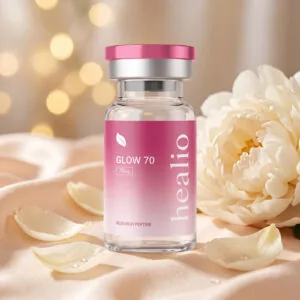 GLOW Peptide Blend
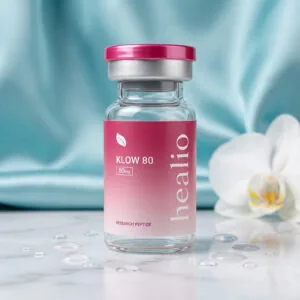 KLOW Peptide Blend
GLOW vs KLOW: what is the difference?
The difference is KPV, and nothing else. GLOW is the base: a copper peptide plus two repair peptides. KLOW is that base plus a tripeptide studied for inflammatory signaling. The base compounds are present in the same amounts in both vials, so any research difference between the blends comes from the 10mg of KPV. Whether that extra compound helps a study or only adds a variable depends on the endpoint, which the sections below take in turn.
GLOW vs KLOW peptide side by side
The table holds the contents and the facts that rarely change, plus size, price and batch data pulled live from the product and certificate pages. Searched as KLOW vs GLOW peptide or GLOW vs KLOW blend, the table is the same.
| GLOW 70 | KLOW 80 | |
|---|---|---|
| Vial | 70mg | 80mg |
| GHK-Cu | 50mg | 50mg |
| BPC-157 | 10mg | 10mg |
| TB-500 | 10mg | 10mg |
| KPV | None | 10mg |
| Price per vial | $104.99 | $119.99 |
| Latest batch purity (HPLC) | 99.3% | 99.2% |
| Certificate | GLOW COA | KLOW COA |
What is in the GLOW peptide blend
Three compounds, each with its own literature. GHK-Cu is reviewed in Pickart’s paper on the tripeptide and tissue remodeling and in a later review of its regenerative actions. BPC-157 is covered by the 2025 systematic review in HSS Journal, which kept 36 studies from 544 articles, 35 of them preclinical. TB-500 is sold as a fragment of thymosin beta-4, and Sosne’s FASEB Journal review describes short sequences within thymosin beta-4 that carry wound-healing and cell-migration activity. The GLOW 70 peptide blend guide explains the formulation.
What KPV adds to KLOW
KPV is the C-terminal tripeptide of alpha-MSH: lysine, proline, valine. Dalmasso and colleagues in Gastroenterology showed that KPV enters intestinal cells through the PepT1 transporter and reduced inflammation in mouse colitis, and Kannengiesser and colleagues in Inflammatory Bowel Diseases reported anti-inflammatory activity in two murine models of inflammatory bowel disease. That is what KLOW buys over GLOW: a compound studied for the inflammatory side of injury. The KPV peptide benefits page goes through the rest, and KLOW vs KPV compares the blend with KPV alone.
When KPV is surplus
KPV only matters when inflammation is an endpoint. A study of skin remodeling, collagen or cell migration measures things the base three compounds are studied for, and a fourth compound that targets inflammatory signaling adds a variable without a matching measurement. In that case GLOW is the cleaner vial. A study of injury, gut or skin irritation models where the inflammatory readout is the point is where KPV earns its place. The extra compound is useful or surplus depending on what you plan to measure.
Why GHK-Cu carries most of the weight in both blends
By mass, GHK-Cu is 50mg of 70 in GLOW, about 71 percent, and 50mg of 80 in KLOW, about 63 percent. Each of the other compounds is 10mg. So in both blends, the copper peptide dominates the vial, and the BPC-157, TB-500 and KPV each take a smaller share. That ratio is fixed, and it can’t be changed without changing the product. A study that wants a different ratio needs the single-compound vials. The GHK-Cu vs GLOW and GHK-Cu vs KLOW pages cover that side.
Two ways to build KLOW from GLOW
Because KLOW is GLOW plus KPV, there’s a route to the same contents from two listings. GLOW 70 and a 10mg KPV vial together hold exactly what KLOW 80 holds, and at the lowest listed sizes they come to $149.98, against $119.99 for KLOW 80. The two-vial route lets a study run GLOW alone as a control, add KPV in a second arm, or vary how much KPV is used. The single vial is simpler and fixes the ratio. Which is better is a design question, and the live figures show what each route costs today.
GLOW vs KLOW for skin research
For skin remodeling models, the base three compounds are the relevant ones, and both blends carry them. KLOW’s extra KPV is relevant only if the skin model has an inflammatory component, such as irritation. If it doesn’t, the extra compound is a variable. That is the single most useful rule for choosing between them: match the vial to the endpoint.
GLOW vs KLOW for recovery and inflammation research
Where inflammation is the measured outcome, KLOW has a compound aimed at it and GLOW doesn’t. BPC-157 and TB-500 are in both, and the HSS review links BPC-157 to lower inflammatory cytokines as part of its repair findings, so GLOW isn’t free of inflammation-relevant biology. KLOW adds a dedicated inflammatory-signaling compound on top of that. The peptides for inflammation guide covers what each compound was studied for.
The thing neither blend has: a study of the blend
No published paper tests GLOW or KLOW as a blend at these ratios. Each component has its own record, and the blends are assembled from them. A result from one component can’t be extended to the mixture without an assumption that nobody has tested, which is that the compounds don’t interfere with each other and that the ratios matter in the same way. Everything in the table above is a statement about individual compounds.
Three questions that settle GLOW vs KLOW
First, is inflammation an endpoint? If the study measures an inflammatory readout, KLOW’s KPV is relevant, and if it doesn’t, GLOW is the cleaner vial. Second, does the design need to vary the ratio? A fixed ratio suits a pilot, and a design that wants to change one compound’s share needs separate vials. Third, does the study need a control that leaves one ingredient out? GLOW is exactly KLOW without KPV, which makes it the natural control for the question of what KPV adds. If the answers are no, no and no, the lower-priced GLOW does the job. If any answer is yes, KLOW or the two-vial route earns its extra cost.
GLOW vs KLOW peptide research in women
Skin and recovery models are where women researchers often start, and the animal evidence for the components doesn’t answer sex-specific questions on its own. The BPC-157 repair work leaned on male animals, the GHK-Cu record is largely review and cell work, and the KPV papers are rodent studies. A woman reading across to her own question will want sex-stratified results, and for this set they are scarce. The BPC-157 research gap in women covers the repair side.
GLOW and KLOW COA: what the lab reports show
Every Healio Peptides batch is tested by an independent US laboratory before release, and the report is published before you order. These are the current two.
| GLOW 70 | KLOW 80 | |
|---|---|---|
| Batch | HEALIO-GLOW70-2617 | HEALIO-KLOW80-2618 |
| Purity (HPLC) | 99.3% | 99.2% |
| Identity (ESI-MS) | Confirmed for each component | Confirmed for each component |
| Endotoxins (LAL) | Under 0.5 EU/mg (limit 5 EU/mg) | Under 0.5 EU/mg (limit 5 EU/mg) |
A blend certificate has more to confirm than a single-compound one, because the report has to account for every component in one vial. Match the batch and lot numbers to the vial. Reading a peptide certificate of analysis explains every row.
GLOW vs KLOW price and format
GLOW 70 is $104.99 and KLOW 80 is $119.99, so GLOW 70 is 13% lower than KLOW 80. The difference is the 10mg of KPV, and a KPV vial on its own is $44.99. Both are lyophilized powder and reconstitute with bacteriostatic water for sale. Reconstituting a blend isn’t the same as reconstituting one compound, because the concentration of each ingredient follows from the vial’s ratios, and the GLOW calculator and KLOW calculator show the arithmetic. How to reconstitute peptides covers the handling.
Where to buy GLOW and KLOW for research
Whichever supplier you use, look for a published certificate before anything else. Every Healio Peptides batch ships with a third-party report, and orders go out from the United States. Start with the GLOW peptide blend for sale and KLOW peptide blend for sale pages, both of which carry the certificate before you order.
GLOW vs KLOW peptide: frequently asked questions
Is KLOW just GLOW with an extra compound?
Yes. KLOW 80 holds the same 50mg of GHK-Cu, 10mg of BPC-157 and 10mg of TB-500 as GLOW 70, plus 10mg of KPV.
Which is better, GLOW or KLOW?
Neither wins on the evidence. KLOW adds a compound studied for inflammatory signaling, which helps a study with an inflammatory endpoint and adds a variable to one without.
Why is KLOW more expensive than GLOW?
KLOW is the larger vial and holds one more compound. The live price table above shows the current gap.
Has the GLOW or KLOW combination been studied?
Not as a blend in the papers cited here. Each component has its own research, and the blends are assembled from those literatures.
Can GLOW and KLOW be reconstituted the same way?
The handling is the same for both: bacteriostatic water added slowly down the vial wall, no shaking. The concentration math differs because the vial strengths differ, and the calculators show it.
Are GLOW and KLOW FDA approved?
Neither is approved as a drug for human use, and nothing on this page is medical advice. Healio Peptides sells both strictly for laboratory research.
More on GLOW and KLOW
- GLOW vs NAD+, a blend against a coenzyme.
- KLOW vs the Wolverine stack, the blend against the BPC-157 and TB-500 pair.
- KLOW vs KPV, the blend against one of its ingredients.
Healio Peptides supplies research compounds for laboratory use only. They are not for human or veterinary use, have not been evaluated by the FDA, and nothing on this page is medical advice.