
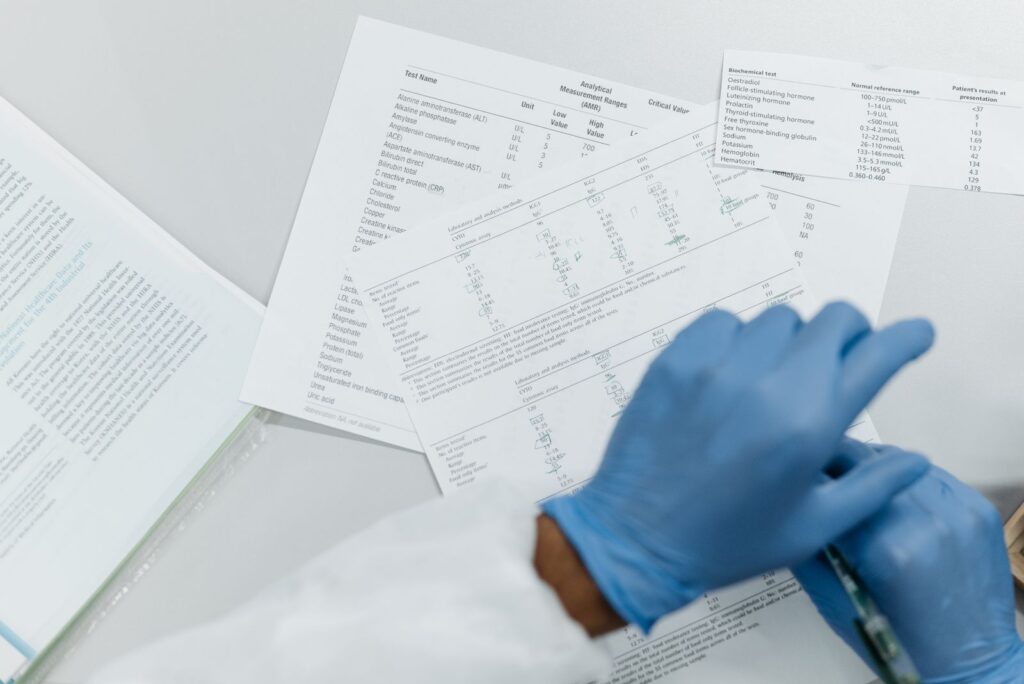
A certificate of analysis is the only document that tells you what is actually in a vial. Everything else on a product page is a claim. The COA is the evidence, and it is the one thing worth learning to read before you spend money anywhere in this industry, including here.
The good news is that it takes about ten minutes to learn. COAs look intimidating because they contain chromatography output and analytical terminology, but the parts that matter for a buying decision are few, specific, and checkable without any chemistry background. This is a walkthrough of those parts, in the order you should look at them. Healio publishes a COA for every batch before purchase, so you can follow along against a real document rather than a description of one.
Start at the bottom: who ran the test
Counterintuitive, but this is the first thing to check, and it disqualifies more documents than any other single item.
Look for a named laboratory. An actual company name, ideally with contact details or a report number that could be verified independently. What you do not want to see: “third-party tested” with no lab named, an unbranded document, or a logo belonging to the seller themselves.
A seller testing its own product and calling that a certificate of analysis is not committing fraud exactly, but it is removing the entire point of independent verification. If the lab is not named, nothing else on the page is worth reading, because there is no one standing behind the numbers.
Check the batch number against your vial
The second check, and the one most people skip entirely.
A COA covers one specific batch, also called a lot. That identifier should appear on the document and on the physical vial label, and they should match. A COA from a different batch tells you about a different production run, which is to say it tells you nothing useful about what you received.
This is the most common way a technically genuine document gets used misleadingly. A seller runs one good test, publishes it permanently, and keeps selling batches that document never covered. The test was real. Its relationship to your vial is fictional.
Also check the test date. A document from two years ago attached to current stock is the same problem wearing a different hat.
Read the purity figure, and know what it excludes
Now the number everyone looks at first. Purity is usually expressed as a percentage, commonly determined by HPLC, and for research-grade peptides you should generally expect 98 percent or higher.
Here is what that figure does and does not mean. Purity tells you what proportion of the peptide content in the sample is the target compound rather than related synthesis byproducts. It does not tell you the compound is the right one. It does not account for water content, residual solvents, or other non-peptide material unless those are separately reported.
So a 99 percent purity figure is genuinely good information and genuinely incomplete on its own. Which brings us to the check that most buyers never make.
Confirm identity, not just purity
This is the section that separates a serious COA from a decorative one.
Purity asks how much of the sample is the stated compound. Identity asks whether the compound is what the label says at all. Those are different questions, answered by different tests, and a document can score beautifully on the first while never addressing the second.
Identity is typically confirmed by mass spectrometry, which measures molecular weight. On the document you are looking for an observed or measured mass compared against a theoretical or expected mass for that peptide sequence. If those two figures match closely, the molecule is what it claims to be.
A 99 percent pure sample of the wrong compound is a real thing that exists, and a purity-only COA cannot detect it. Any supplier serious about verification reports both.
What the chromatogram is actually showing
The busy graph with the tall spike is an HPLC chromatogram, and you do not need to interpret it in detail. You need to recognize two features.
One dominant peak means one dominant compound, which is what you want. Multiple substantial peaks mean multiple substantial compounds present, which contradicts a high purity claim regardless of what number is printed elsewhere on the page.
The percentage figure is usually derived from the relative area under those peaks. So the graph and the purity number should tell the same story. When they disagree, the graph is the more honest of the two, because it is raw output rather than a summary someone typed.
The terms you will actually encounter
A short glossary, because unfamiliar abbreviations are most of what makes these documents feel closed to non-specialists.
HPLC stands for high performance liquid chromatography. It separates the components of a sample so their relative proportions can be measured, which is where the purity percentage comes from.
MS is mass spectrometry, which measures molecular weight and is how identity gets confirmed. You may see it written as LC-MS or ESI-MS, both of which are fine.
Retention time is how long a component took to move through the chromatography column. It is a fingerprint-like property, useful for confirming consistency between runs.
Peak area is the measured size of each peak on the chromatogram, and the ratio between peak areas is what produces the purity figure.
Water content, sometimes reported by Karl Fischer titration, matters because lyophilized peptides absorb moisture. It is reported separately from peptide purity, which is why a high purity figure and a meaningful water content can appear on the same document without contradiction.
That is genuinely the whole vocabulary needed. Anything else on the page is detail supporting one of these five.
A practical checklist
Everything above, condensed into what to actually do when comparing two suppliers.
- Is an independent laboratory named, not merely referenced?
- Does the batch or lot number match the vial you received or are being sold?
- Is the test date recent enough to plausibly cover current stock?
- Is purity stated as a specific percentage rather than a vague claim?
- Is identity confirmed separately, typically by mass spectrometry?
- Does the chromatogram show one dominant peak consistent with the stated purity?
- Is the document published openly rather than supplied only after purchase?
Seven items. A document clearing all seven is a real verification record. A document clearing three is marketing with a chart on it.
Why published beats available on request
That last checklist item deserves its own explanation, because it sounds like a minor preference and is not.
A COA supplied only after purchase, or only when a customer specifically asks, gives the seller control over which document reaches which buyer. Publishing every batch openly removes that discretion entirely. Anyone can check any batch at any time, including a competitor, including a regulator, including someone who has not bought anything.
That is a meaningfully different commitment from a promise to provide documentation on request, and it is the standard worth holding suppliers to. Our approach and our reasoning are laid out in more detail in our comparison of what separates peptide suppliers, which applies the same criteria to us as to anyone else.

Red flags worth walking away from
Some patterns recur often enough to name directly, and each one has a plausible-sounding cover story attached.
The image with no document behind it. A cropped screenshot of a chromatogram, no lab header, no batch number, no page two. It looks like evidence at thumbnail size and contains none.
One COA covering an entire catalog. Each compound and each batch requires its own testing. A single document presented as verification for a whole product range is describing something that cannot exist.
Purity claimed in marketing copy but absent from the document. A product page saying 99 percent pure, attached to a COA that reports no purity figure at all, means the number came from somewhere other than the analysis.
A test date that never changes. If the same document has sat on a product page for eighteen months across many restocks, it stopped describing current inventory a long time ago.
None of these require expertise to spot, which is the useful part. They require only the habit of actually opening the document instead of noting that one exists.
What a COA will never tell you
Worth stating plainly, since a good document can create a false sense of completeness.
A certificate of analysis describes what is in the vial. It says nothing about whether the compound is appropriate for any purpose, whether the research it is associated with is well-designed, or whether marketing claims built on top of it are accurate. A perfectly clean COA on a compound with a thin research base is exactly that: a clean COA on a thinly researched compound.
Verification and evidence are separate axes. Our guides to individual compounds, including longevity peptides and tendon healing research, cover the second question, which no analytical document can answer.
Where to see this in practice
Reading a description of a COA is less useful than reading one. Every batch Healio ships has its certificate published before purchase, and running the seven checks above against a real document takes a few minutes and makes the next comparison much faster.
The compounds themselves sit across the healing, anti-aging, and weight loss collections, each carrying its own batch documentation rather than a single site-wide certificate standing in for everything.
Frequently asked questions
What is a certificate of analysis?
A document from an analytical laboratory reporting what a specific batch of material contains, typically including purity, identity confirmation, and supporting chromatography output. It is the primary evidence of what is actually in a vial.
What purity should a research peptide COA show?
Research-grade peptides generally report 98 percent or higher by HPLC. The figure matters less than whether identity is confirmed separately, since high purity of the wrong compound is possible.
What is the difference between purity and identity testing?
Purity measures what proportion of the sample is the target compound versus byproducts. Identity confirms the compound is what the label claims, usually by mass spectrometry comparing observed against expected molecular weight.
Why does the batch number matter?
A COA covers one production run. If the batch number on the document does not match the vial, the testing describes different material and tells you nothing reliable about what you received.
Is a seller-run test acceptable?
It removes the independence that makes verification meaningful. Look for a named external laboratory, as covered on our published batch certificates where every batch document identifies the testing facility.
Should a supplier publish COAs or provide them on request?
Published is a stronger commitment. Supplying documents only on request lets a seller choose which document reaches which buyer, while open publication makes every batch checkable by anyone at any time.
Compounds discussed above, each shipped with a published batch certificate: BPC-157, GHK-Cu, retatrutide. The full catalogue carries the wider range.
Ten minutes that changes how you shop
Once these seven checks are habit, most of this industry sorts itself very quickly. The suppliers publishing complete, current, batch-matched documentation are a much shorter list than the suppliers claiming to be third-party tested, and the gap between those two groups is where most of the risk in this market lives. Every batch we ship is documented before purchase, and it is worth comparing against anyone else you are considering.
Related reading
- Best Peptide Companies, the supplier criteria this document sits inside.
- How to Reconstitute Peptides, the lab handling side of the same practical knowledge.
- Bacteriostatic Water for Peptides, what the standard diluent is and why it matters.
- Best Peptides for Women, the hub guide covering compounds by research goal.