
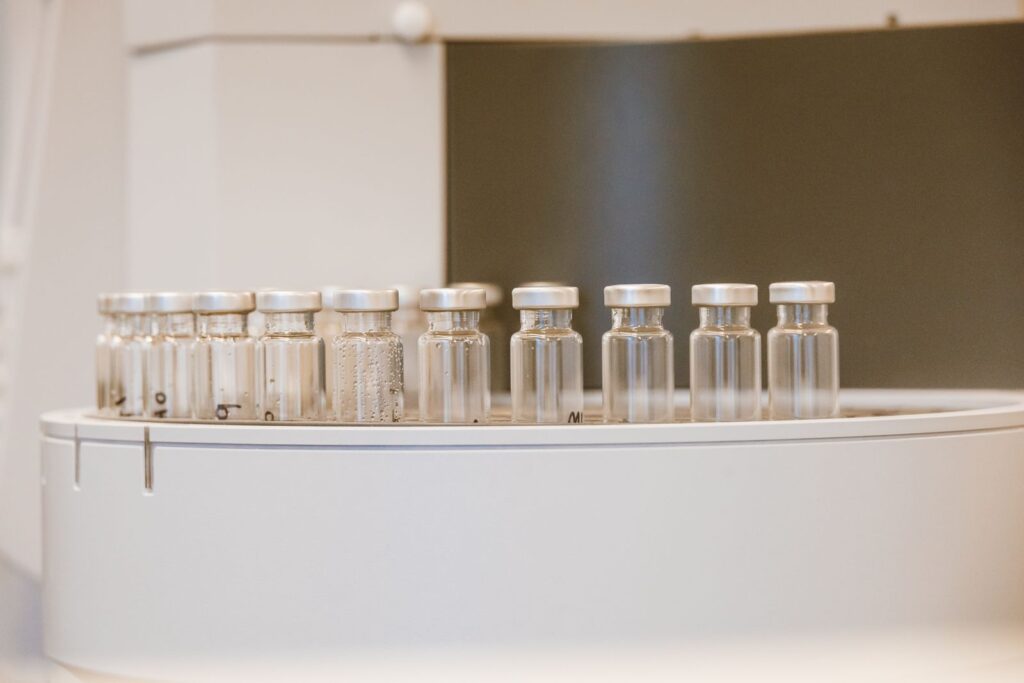
A lyophilized peptide vial looks like almost nothing. A thin white film across the bottom of the glass, or a small puck of powder that could pass for dust. It is easy to look at that and assume the hard part is over, when in fact the step that most often wrecks a vial is the one that comes next.
Reconstitution is the process of turning that powder back into a solution. Done carefully it takes about four minutes. Done carelessly it can denature the compound, contaminate the vial, or leave a researcher with a solution of unknown concentration, which is arguably the worst outcome of the three because nothing about it looks wrong. This guide covers how to reconstitute peptides as a laboratory procedure, what the solvent choice actually changes, and how long the resulting solution stays intact.
What reconstituting peptides actually means
Peptides are shipped as lyophilized powder because peptides in water do not last. Lyophilization, or freeze-drying, removes the water under vacuum while the material is frozen, which leaves behind a dry solid that is stable at room temperature for a surprisingly long time.
Water is what starts the clock. In solution, peptide bonds are exposed to hydrolysis, oxidation, and the enzymatic activity of anything that gets into the vial. So the powder is the storage format and the solution is the working format, and the transition between them is deliberate rather than incidental.
That is the whole logic behind the procedure below. Adding solvent ends a stable state on purpose and starts a countdown, so every choice from that point onward is about slowing the countdown down.
One thing worth being direct about: everything on this page is written for laboratory handling of research compounds. Healio does not publish administration instructions, dosing schedules, or anything resembling them, and you will not find them here. What follows is bench procedure.
Bacteriostatic water vs sterile water for peptide reconstitution
This is the fork in the road, and it gets glossed over constantly.
Sterile water is water with nothing living in it at the moment it was sealed. It contains no preservative. Once a needle goes through the stopper, whatever was on that needle is now in the vial, and the water has no way to stop it multiplying.
Bacteriostatic water is sterile water with 0.9 percent benzyl alcohol added, the concentration named on the FDA labelling. Benzyl alcohol does not kill bacteria outright, which is what the “static” in bacteriostatic means. It suppresses their ability to reproduce. That distinction matters because it is what makes a vial usable across multiple withdrawals over a period of weeks rather than a single session.
For most research work involving repeated sampling from the same vial, bacteriostatic water is the sensible default. It is the reason a reconstituted vial can sit in a fridge for a month instead of being discarded the same afternoon.
There are two exceptions worth knowing. Some peptides are poorly soluble in plain water and dissolve better with a small amount of dilute acetic acid or, occasionally, sterile saline. And a handful of compounds are sensitive to benzyl alcohol. Where a supplier specifies a solvent, that specification wins over any general rule, including this one.
What you should not use: tap water, distilled water from a hardware store, drinking water, or the leftover saline from something else. None of those are sterile, and two of them contain minerals that will happily interact with your compound.
How to reconstitute peptides step by step
What you need on the bench first
- The lyophilized peptide vial, still sealed
- Bacteriostatic water, or whatever solvent the supplier specified
- A sterile syringe with a fine needle
- Alcohol wipes
- A permanent marker and a label
The marker is not an afterthought. An unlabeled reconstituted vial is a vial of unknown concentration and unknown age, and there is no way to recover that information later by looking at it.
The procedure
1. Let both vials reach room temperature. Cold glass and cold solvent slow dissolution and encourage condensation. Ten to fifteen minutes on the bench is enough.
2. Wipe both stoppers with alcohol and let them dry. Dry matters. Alcohol carried into the vial on a wet stopper is alcohol in your solution.
3. Draw the calculated volume of solvent. The math for this is in the next section. Draw it slowly and check for air.
4. Angle the needle so the stream runs down the glass wall. This is the step people skip, and it is the one that matters most. Injecting solvent directly onto the peptide film blasts it, and the shear force can denature the compound before it ever dissolves. Aim for the wall and let the liquid pool at the bottom.
5. Do not shake it. Ever. Shaking creates foam, foam is an air and liquid interface, and peptides denature at that interface. If the vial foams, you have already lost some of what you paid for. Swirl it gently instead, or simply set it down and wait.
6. Wait for it to go clear. Most peptides dissolve within a few minutes at room temperature. Some take longer. A gentle roll between the palms is fine. A stubborn one can be left for twenty minutes before you start troubleshooting.
7. Inspect it against a light background. A correctly reconstituted vial is clear and colorless with no floating particles, no cloudiness, and no film on the surface. Anything else is a signal, not a cosmetic issue.
8. Label it. Compound, concentration in mg per mL, date reconstituted. Then refrigerate.
Peptide reconstitution math: how much bacteriostatic water per vial
The arithmetic is simpler than it looks, because there is only one equation and it never changes.
Concentration = total mg in the vial divided by mL of solvent added.
A 10mg vial with 2mL of bacteriostatic water gives 5mg/mL. The same 10mg vial with 5mL gives 2mg/mL. Nothing about the peptide changed. Only the dilution did.
| Vial size | Solvent added | Resulting concentration |
|---|---|---|
| 5mg | 1mL | 5mg/mL |
| 5mg | 2mL | 2.5mg/mL |
| 10mg | 2mL | 5mg/mL |
| 10mg | 5mL | 2mg/mL |
| 15mg | 3mL | 5mg/mL |
Two practical constraints sit on top of the math. The vial has to physically hold the volume, and a standard 2mL peptide vial will not accept 5mL no matter how good the reasoning is. And more dilute solutions make small volumes easier to measure accurately, which is why researchers working with fine gradations often prefer them.
Vial sizes vary by compound, so check the product page before calculating. The strengths listed for BPC-157 and retatrutide, for instance, are not the same, and neither is what a full vial of each will hold.
Do peptides need to be refrigerated before reconstitution?
No. Lyophilized peptide powder is stable at room temperature for weeks and does not require refrigeration during shipping or short-term storage. Refrigeration extends shelf life and is sensible for anything being kept for months, but a vial that spent three days in a warm mailbox has not been ruined.
If you skipped straight to this heading, that is fine, and you are in good company. It is the most searched question about a peptide order by a wide margin, and the reassuring answer happens to be the correct one. Freeze-drying exists so the material can survive ordinary logistics.
For longer holds, a fridge at 2 to 8°C is fine and a freezer at -20°C is better. What actually degrades dry powder is humidity and repeated temperature swings. Light does damage too, over months rather than days. Which is a long way of saying a vial should not live on a windowsill or get moved in and out of the freezer every few days.
How long reconstituted peptides last in the fridge
Once there is water in the vial, stability is measured in weeks rather than years.
The commonly cited window for a peptide reconstituted with bacteriostatic water and kept refrigerated is roughly three to four weeks, and it varies by compound. Peptides with methionine, cysteine, or tryptophan residues are more prone to oxidation and tend toward the shorter end. Smaller, simpler sequences hold up better.
Sterile water changes the picture entirely. With no preservative, a vial should be treated as single-session material once the seal is broken.
Four things shorten the window, and none of them are subtle:
- Light. Store the vial in its box or in a dark corner of the fridge.
- Temperature cycling. Leaving it out on the counter between uses undoes the point of refrigerating it.
- Repeated punctures. Every entry through the stopper is a contamination opportunity, and stoppers do not reseal indefinitely.
- Freezing a solution. Ice crystal formation can shear peptide structures. Freeze the powder, not the solution.
Visual inspection is the check that costs nothing. Cloudiness, particulates, discoloration, or anything that was not there on day one means the vial is done. There is no version of that assessment where the right answer is “probably fine.”
Mistakes that ruin a reconstituted peptide vial
Almost every failed reconstitution comes from the same short list, and shaking sits at the top of it. The urge to speed things up is completely understandable. It is also how you foam a vial into uselessness. Spraying solvent straight down onto the powder is the quieter version of the same mistake, slower to show up and just as damaging.
Then there is the measurement. “About 2mL” produces a solution of about-unknown concentration, and every measurement taken from that vial afterward inherits the uncertainty. Skipping the label compounds it. Three identical vials in a fridge door, reconstituted on different dates at different concentrations, is a problem with no solution other than throwing all three away.
Reusing a needle is the one that gets rationalized most often, usually on the grounds that the solvent is bacteriostatic. It suppresses bacterial growth. It does not sterilize whatever you just introduced.
And the last one runs the other way: assuming a stubborn vial is a bad vial. Some compounds genuinely take their time. Twenty minutes at room temperature with the occasional gentle swirl, and only then start worrying.
Why peptide purity affects how a vial reconstitutes
A vial that will not go clear, or that goes cloudy and stays that way, is sometimes a technique problem. Sometimes it is a materials problem.
Peptide synthesis produces the target sequence alongside truncated fragments, deletion sequences, and residual solvents from the process. Purification removes most of that. How much it removes is what the purity figure on a certificate of analysis describes, and the gap between 95 percent and 99 percent is not a rounding difference when the remainder is behaving unpredictably in solution.
The certificate is the only way to know. Third-party lab, batch number matching the vial in your hand, purity by HPLC, identity confirmed by mass spectrometry. Healio publishes every batch certificate before purchase rather than on request afterward, and the bacteriostatic water that goes with them is stocked alongside. If you are sourcing compounds for tissue repair or metabolic work, the peptides for healing collection and the weight loss peptide collection are where those batches live.
How to reconstitute peptides: frequently asked questions
How much bacteriostatic water do you use to reconstitute peptides?
It depends on the concentration you want, not on the peptide. Divide the milligrams in the vial by the milliliters of solvent to get mg/mL. A 10mg vial with 2mL of bacteriostatic water yields 5mg/mL. The physical limit is the vial’s capacity, which is usually 2mL or 3mL.
How long do reconstituted peptides last in the fridge?
Roughly three to four weeks when reconstituted with bacteriostatic water and stored at 2 to 8°C, varying by compound. Sequences containing methionine, cysteine, or tryptophan degrade faster. With plain sterile water there is no preservative, so the usable window is a single session.
Do powder form peptides need to be refrigerated before reconstitution?
No. Lyophilized powder is stable at room temperature for weeks, which is why peptides ship without cold chain packaging. Refrigeration or freezing extends shelf life for long-term storage, but a shipment that sat in a warm mailbox for a few days is not compromised.
Can you freeze reconstituted peptides?
It is not recommended. Ice crystals forming in solution can shear peptide structures, and repeated freeze-thaw cycles compound the damage. Freeze the lyophilized powder if you need long-term storage, and keep anything already in solution refrigerated instead.
Why is my reconstituted peptide vial cloudy?
Cloudiness usually means aggregation, incomplete dissolution, or contamination. Give a stubborn vial twenty minutes at room temperature with gentle swirling first. If it stays cloudy, or if it clouds days after it was clear, the vial should be discarded. Persistent cloudiness across multiple vials points at purity, which is what a certificate of analysis exists to document.
Related reading
- Peptides for Recovery: what the tissue repair research actually establishes
- Best Peptide Companies in 2026: how to compare suppliers on testing rather than marketing
- Best Peptides for Women: the full picture, sorted by research goal
- Bacteriostatic Water for Peptides: the solvent itself, in full
- How to Read a Certificate of Analysis: the document to check before you open anything
- Peptide calculator, working out concentration from vial strength and water volume.