
GLOW peptide and NAD+ turn up in the same searches about skin, aging and cellular energy, and the comparison hides a basic category difference. GLOW 70 is a blend of three peptides: 50mg of GHK-Cu, 10mg of BPC-157 and 10mg of TB-500. NAD+ is not a peptide at all. It is a coenzyme every cell already makes, a hydrogen carrier in redox reactions and a signaling molecule. One is a mixture of signaling peptides studied for tissue remodeling and repair, and the other is a metabolite studied mostly through its precursors. This GLOW peptide vs NAD+ comparison covers what each one is, what the studies found, what a COA should show, and why the comparison is a matter of different questions. Everything below describes laboratory research.
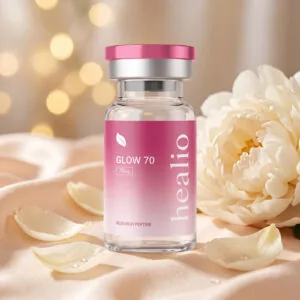 GLOW Peptide Blend
GLOW peptide vs NAD+: what is the difference?
GLOW is a three-compound peptide blend whose components are studied in skin remodeling, wound repair and cell migration. NAD+ is a small molecule studied in energy metabolism and aging, and nearly all human work uses a precursor such as nicotinamide riboside or nicotinamide mononucleotide to raise it. They don’t share a mechanism, a literature or a kind of evidence. A study that picks one is asking about tissue signaling, and a study that picks the other is asking about cellular redox and metabolism.
GLOW vs NAD+ side by side
The table holds the facts that rarely change. GLOW’s size, price and batch data are pulled live from the product and certificate pages, and the NAD+ cells say what to ask a seller. Searched as NAD+ peptide vs GLOW or GLOW peptide vs NAD, the table is the same.
| GLOW 70 | NAD+ | |
|---|---|---|
| What it is | A blend of GHK-Cu, BPC-157 and TB-500 | A coenzyme, not a peptide |
| Contents | 50mg GHK-Cu, 10mg BPC-157, 10mg TB-500 | One molecule |
| Main areas studied | Tissue remodeling, repair, cell migration | Redox metabolism, energy, ageing biology |
| How human work is done | Components studied separately, mostly preclinical | Precursor trials in adults, reviews of mechanism |
| Size and price | 70mg vial, $104.99 | Varies by seller |
| Latest batch purity (HPLC) | 99.3% | Ask the seller for the batch report |
| Certificate | GLOW COA | Ask the seller for the certificate |
What NAD+ is and what its research covers
Rajman and colleagues in Cell Metabolism describe NAD as the cell’s hydrogen carrier for redox enzymes that has also emerged as a signaling molecule, with levels that decline steadily with age, and note that restoring NAD+ in old or diseased animals can promote health and extend lifespan. Covarrubias and colleagues in Nature Reviews Molecular Cell Biology review NAD+ metabolism across ageing. The human work mostly uses precursors. Martens and colleagues in Nature Communications found that chronic nicotinamide riboside was well tolerated and raised NAD+ in healthy middle-aged and older adults. Yoshino and colleagues in Science ran a 10-week randomized, placebo-controlled trial of nicotinamide mononucleotide in postmenopausal women with prediabetes who were overweight or obese, and reported increased muscle insulin sensitivity. The BPC-157 vs NAD+ page, BPC-157 vs NAD+, covers the same coenzyme from the repair side.
What the GLOW peptides’ research covers
Each component has its own literature, and none of it mentions NAD+ or the blend. GHK-Cu is reviewed in Pickart’s paper on the tripeptide and tissue remodeling and in a later review of its regenerative actions. BPC-157 is covered by the 2025 systematic review in HSS Journal, which kept 36 studies from 544 articles, 35 of them preclinical. TB-500 is sold as a fragment of thymosin beta-4, and Sosne’s FASEB Journal review describes the short active sequences within thymosin beta-4 that carry wound-healing and cell-migration activity. The GLOW 70 peptide blend guide explains the formulation.
Different kinds of evidence: a precursor trial and a preclinical record
The two records are built differently. NAD+ has human trials, but they test precursors, and the outcomes are NAD+ levels and metabolic markers in specific groups. The GLOW components have a deep preclinical record and almost no human trials of the blend. A direct reading is that NAD+ research tells you what happens when you raise a metabolite in adults, and GLOW research tells you what each peptide did in a model. Neither tells you what the other would do, and a page that ranks one over the other is comparing a human metabolic result with a mouse or cell result.
Where GLOW and NAD+ meet: skin, ageing and the same searches
People who search GLOW peptide vs NAD+ are usually circling the same interest, skin and ageing biology, from two directions. GHK-Cu is studied in tissue remodeling, and NAD+ in the metabolic machinery that declines with age. They don’t compete for the same job, and they could be probed in the same model as separate arms. No paper cited here tests them together. The copper peptides for skin page covers the GHK-Cu side in more detail.
Precursors are not NAD+ itself
A detail that gets lost in comparison pages: the human trials above gave participants precursors, not NAD+. Martens gave nicotinamide riboside and measured whether NAD+ rose, and Yoshino gave nicotinamide mononucleotide and measured muscle insulin signaling. Rajman’s review frames the whole field as a search for safe NAD-boosting molecules, which is an honest description of the state of play: the goal is to raise a level, and the tools are indirect. So a seller offering NAD+ itself is offering a different thing from what the trials tested, and a result with a precursor doesn’t carry over automatically. That is one more reason a certificate matters, since it states what the vial contains.
Reading NAD+ and GLOW claims on social media
Short videos pair NAD+ with peptides as part of an ageing or skin routine and describe the result in confident terms. The papers cited here don’t test a routine. They test a precursor in adults, a coenzyme’s role in cells, or a peptide in a cell or animal model. A claim that connects them, for example that raising NAD+ makes a copper peptide work better, would need a study that measured both together, and none of the papers cited here did. Treat those posts as a source of questions, which the studies can then be checked against.
GLOW vs NAD+ in women’s research
The Yoshino trial is useful here because it enrolled postmenopausal women. It is one trial, in one defined group, over 10 weeks, and it measured insulin sensitivity, so it doesn’t speak to skin or other outcomes. The GLOW components were studied mostly in animal and cell systems, where the abstracts don’t report results by sex. A woman framing her own question will want sex-stratified data, and for both sides it is thin. The women’s wellness peptides category shows the neighboring compounds.
What the GLOW and NAD+ studies can’t tell you
NAD+ precursor trials show that levels can be raised, and that doesn’t prove a given level change produces a given outcome. The Yoshino result is a 10-week trial in a defined group, and the Science journal later published a comment and response about it, which is a reminder that single trials get argued over. For GLOW, the blend itself hasn’t been the subject of a published paper, so every statement is about a component. Neither record supports a head-to-head ranking.
GLOW COA: what a lab report shows, and what to ask for on NAD+
Every Healio Peptides batch is tested by an independent US laboratory before release, and the report is published before you order. This is the current GLOW 70 batch.
| GLOW 70 | |
|---|---|
| Batch | HEALIO-GLOW70-2617 |
| Purity (HPLC) | 99.3% |
| Identity (ESI-MS) | Confirmed for each component |
| Endotoxins (LAL) | Under 0.5 EU/mg (limit 5 EU/mg) |
A blend certificate has more to confirm than a single-compound one, because the report has to account for three components in one vial. For NAD+, ask for purity by HPLC, an identity result, an endotoxin result and a lot number that matches the vial, and ask which form the vial holds. Reading a peptide certificate of analysis explains each row.
GLOW peptide price and format
Healio Peptides lists GLOW 70 as the 70mg vial, lyophilized powder, at $104.99. Its three compounds, bought as separate vials at the lowest listed sizes, come to $169.97, so the blend is 38% lower than buying them one by one. The sums are calculated live from the listed prices. NAD+ strengths and prices vary by seller, so compare cost per milligram. Reconstitution uses bacteriostatic water for sale, and the GLOW calculator turns vial strength and water volume into a concentration. How to reconstitute peptides covers the handling.
Where to buy GLOW peptide for research
Whichever supplier you use, look for a published certificate before anything else. Every Healio Peptides batch ships with a third-party report, and orders go out from the United States. The GLOW peptide blend for sale page carries the certificate before you order, and the peptides for skin and beauty category shows the neighboring compounds.
GLOW peptide vs NAD+: frequently asked questions
Is GLOW or NAD+ better?
Neither wins on the evidence. They answer different questions: GLOW’s components are studied in tissue remodeling and repair, and NAD+ in redox metabolism and ageing. No paper tests them against each other.
Is NAD+ a peptide?
No. NAD+ is a coenzyme, a hydrogen carrier in redox reactions that also works as a signaling molecule. GLOW is a blend of three peptides.
What is in GLOW peptide?
GLOW 70 holds 50mg of GHK-Cu, 10mg of BPC-157 and 10mg of TB-500 in one 70mg vial.
Has NAD+ been tested in women?
One randomized trial of nicotinamide mononucleotide enrolled postmenopausal women with prediabetes who were overweight or obese, and reported increased muscle insulin sensitivity over 10 weeks. It is a single trial in a defined group.
Are GLOW and NAD+ FDA approved?
Nothing on this page is a statement about any product’s legal status or medical advice. Healio Peptides sells GLOW strictly for laboratory research, and the studies described here are published research, not guidance.
Do GLOW and NAD+ reviews tell me anything useful?
Reviews mix different products, forms and expectations, so they say little about any one vial. A batch certificate says more: it ties a purity and identity result to a lot number you can check.
More on GLOW and NAD+
- GLOW vs KLOW, the two blends differ by exactly one compound.
- GHK-Cu vs GLOW, the copper peptide against the blend built on it.
- BPC-157 vs NAD+, a repair peptide against a coenzyme.
Healio Peptides supplies research compounds for laboratory use only. They are not for human or veterinary use, have not been evaluated by the FDA, and nothing on this page is medical advice.