
Start with the numbers. The Wolverine pair, BPC-157 and TB-500 as two separate vials, comes to $134.98 at today’s listed prices. GLOW 70 is $104.99, and it holds the same two compounds at 10mg each plus 50mg of GHK-Cu. That’s the whole shape of the GLOW peptide vs Wolverine stack question: one pair of repair compounds, and the same pair with a copper peptide added and everything combined in a single vial. The sections below cover what each contains, what the added GHK-Cu brings to the research, what the batch certificates show, and which research question fits which format. Everything describes laboratory research. The listings are linked as we go, for anyone sourcing for a study in the peptides for healing category.
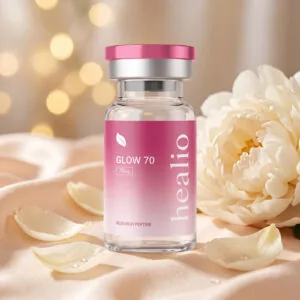 GLOW Peptide Blend
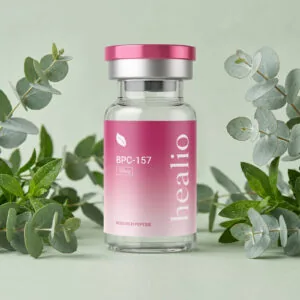 BPC-157
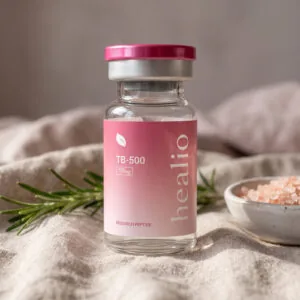 TB-500
GLOW peptide vs Wolverine stack: what is the difference?
The Wolverine stack is BPC-157 plus TB-500, a nickname for two compounds that Healio Peptides sells as separate vials. GLOW 70 is a 70mg vial holding both at 10mg each, with 50mg of GHK-Cu alongside. The difference is the GHK-Cu and the format: two vials against one, two compounds against three. The pair accounts for 20mg of the 70, a little under 30 percent of the GLOW vial by mass.
GLOW peptide vs Wolverine stack side by side
The table holds the fixed facts, plus size, price and batch data pulled live from the product and certificate pages. Searches such as glow peptide vs wolverine, wolverine peptide stack vs glow and wolverine stack vs glow stack all resolve to these two columns.
| Wolverine stack | GLOW 70 | |
|---|---|---|
| What is in it | BPC-157 and TB-500 | GHK-Cu 50mg, BPC-157 10mg, TB-500 10mg |
| Number of compounds | 2 | 3 |
| Share that is the BPC-157 and TB-500 pair | All of it | About 29 percent (20mg of 70mg) |
| Main research areas | Blood vessel formation, cell migration, soft tissue repair models | Those, plus collagen and tissue remodeling |
| Format at Healio Peptides | Two separate vials, 10mg each | One 70mg vial |
| Price | $134.98 for the two vials | $104.99 for the vial |
| Latest batch purity (HPLC) | BPC-157 99.5%, TB-500 99.1% | 99.3% |
| Certificates | BPC-157 COA and TB-500 COA | GLOW 70 COA |
What the Wolverine pair brings
BPC-157 and TB-500 are studied as complements. BPC-157 research reads like a study of supply: new blood vessels and growth factor signaling. TB-500 research reads like a study of movement: actin, and cells getting into position. The 2025 systematic review in HSS Journal is the best single source on BPC-157, and it found one small clinical study among 36 included papers. For TB-500, much of the evidence belongs to the larger thymosin beta-4 protein. The Wolverine stack explainer and the BPC-157 vs TB-500 comparison go deeper on both.
How much of GLOW is the Wolverine pair?
Twenty of the 70 milligrams, which is about 29 percent. The other 71 percent is GHK-Cu. For a study built around the pair, most of the powder in a GLOW vial is a compound the study didn’t ask about. For a study built around GHK-Cu, nearly a third of the powder is two compounds it didn’t ask about. Either way the vial is mostly someone else’s question, and that is the central trade-off of any blend.
What GHK-Cu changes in GLOW
GHK-Cu moves the vial away from pure repair and toward remodeling. It is a copper tripeptide with the longest research record of the three compounds. A 2018 review in the International Journal of Molecular Sciences covers its regenerative and protective actions, and The human tri-peptide GHK and tissue remodeling covers the earlier tissue work. Skin and collagen are its home ground. At 50mg it also dominates the vial, so a result from a GLOW study is more likely to reflect the copper peptide than the 10mg of each repair compound. The GHK-Cu peptide benefits page goes through the findings.
Which research question fits which format
A study aimed at tendon, ligament or muscle repair models maps most directly onto the pair alone. BPC-157 and TB-500 are the compounds with the tissue repair literature, and adding GHK-Cu brings a variable the question didn’t ask about. A study of collagen, skin remodeling or wound closure points at GHK-Cu, and a pair-only setup leaves it out. GLOW suits a design that wants all three mechanisms in one reconstitution, where the 50:10:10 ratio is acceptable as fixed. When a study needs its own ratios, separate vials give control that a blend doesn’t. A careful design with the blend also includes single-compound arms, so any effect can be traced. That is easy when the pair and GHK-Cu are separate listings, and it can’t be done from a GLOW vial, which can’t be unmixed. The reverse holds as well: a pair-only study can add GHK-Cu later without redoing the earlier work. Nothing here ranks one choice above the others, because the right pick follows from what the study measures.
One vial or two: reconstitution compared
The pair takes two vials, two reconstitutions and two sets of arithmetic, and GLOW takes one. Each vial dissolves in bacteriostatic water for sale, and the resulting concentration depends on the vial strength and the water volume. With the pair, the two concentrations are independent, so each can be set on its own. In GLOW, all three compounds share one volume and each concentration follows its share of the vial. At 50:10:10, the GHK-Cu concentration is always five times the BPC-157 concentration and five times the TB-500 concentration. That’s arithmetic, and the GLOW calculator shows the numbers for any water volume.
How to read coverage claims about GLOW and the Wolverine stack
Some comparisons say GLOW offers broader coverage than the Wolverine pair. Statements like that usually add up what each compound has been studied for. It’s a map of literatures, and it isn’t a measured result. A stack with more compounds has more literature behind it, and no study cited here shows that it performs better. Look for the sentence that says which paper tested what, and treat anything without one as a summary of reading rather than a finding.
What the GLOW and Wolverine studies can’t tell you
None of the papers cited on this page tests the three compounds together. Every GLOW claim borrows from three separate literatures, and a blend result can’t be traced back to one ingredient. The pair has the same issue on a smaller scale, since BPC-157 and TB-500 are tested together far less often than apart. Add the sex bias in repair research, where most animal work used males, and a woman applying these findings to her own question is working from gaps. The peptide stacks for women guide covers which gaps matter.
A side question stays open. GHK-Cu is a copper compound, and it shares a vial with two peptides that contain no copper. What that does to each component over time is a question for stability testing, and the identity line on the certificate, which confirms every component is present in the batch tested, is the most any report here can offer on it.
GLOW peptide vs Wolverine stack COA: what the lab reports show
Every Healio Peptides batch is tested by an independent US laboratory before release, and the report is published before you order. These are the three current ones.
| BPC-157 | TB-500 | GLOW 70 | |
|---|---|---|---|
| Batch | HEALIO-BPC157-2605 | HEALIO-TB500-2612 | HEALIO-GLOW70-2617 |
| Purity (HPLC) | 99.5% | 99.1% | 99.3% |
| Identity (ESI-MS) | Confirmed, conforms to the reference standard (1419.56) | Confirmed, conforms to the reference standard | Confirmed for each component |
| Endotoxins (LAL) | Under 0.5 EU/mg (limit 5 EU/mg) | Under 0.5 EU/mg (limit 5 EU/mg) | Under 0.5 EU/mg (limit 5 EU/mg) |
Match the batch and lot numbers to the vial, then open the full reports linked in the first table. If certificates are new to you, reading a peptide certificate of analysis explains each row.
GLOW peptide vs Wolverine stack price and format
The pair as two vials is $134.98 at the lowest listed sizes, and GLOW 70 is $104.99. The vials aren’t equivalent, because GLOW also carries 50mg of GHK-Cu. Priced as separate vials, the same three compounds come to $169.97, so GLOW 70 is 38% lower than buying the contents one by one. The sums are calculated live from the listed prices, so they move when the prices do. Reconstitute with bacteriostatic water for sale, and use the GLOW calculator, BPC-157 calculator or TB-500 calculator to turn vial strength and water volume into a concentration.
Where to buy GLOW and the Wolverine stack for research
Whichever route you take, look for a published certificate first. Every Healio Peptides batch ships with a third-party report, and orders go out from the United States. The pair is the BPC-157 listing and the TB-500 listing, and the three-compound vial is the GLOW 70 listing.
GLOW vs Wolverine stack: frequently asked questions
Is GLOW better than the Wolverine stack?
Neither wins on the evidence. GLOW adds GHK-Cu to the pair, which helps if a study asks about collagen or skin remodeling and does nothing for one that doesn’t. Which is better depends on the measurement.
What is the difference between GLOW and Wolverine?
Wolverine is BPC-157 plus TB-500. GLOW 70 is those two at 10mg each plus 50mg of GHK-Cu, in one vial.
Does GLOW contain the Wolverine stack?
Yes. Each GLOW 70 vial holds 10mg of BPC-157 and 10mg of TB-500, the same amounts as the two single-compound listings, and 50mg of GHK-Cu on top.
Can the Wolverine stack and GHK-Cu be studied separately?
Yes. Healio Peptides lists BPC-157, TB-500 and GHK-Cu for sale as separate products, so a study can set its own ratio. GLOW 70 fixes it at 50:10:10.
How do GLOW, KLOW and the Wolverine stack compare?
The Wolverine pair is the base, GLOW adds GHK-Cu, and KLOW adds KPV on top of GLOW. The KLOW vs Wolverine stack page and GLOW vs KLOW cover the other steps.
Are GLOW and the Wolverine stack FDA approved?
Neither is approved as a drug for human use, both sit almost entirely in animal and cell research, and nothing on this page is medical advice. Healio Peptides sells them for laboratory research only.
More on GLOW and the Wolverine stack
- GLOW peptide benefits, the three compounds broken down one at a time.
- GHK-Cu vs GLOW, the single copper peptide against the blend built on it.
- Peptides for healing tendons, how to read the tendon data carefully.
Healio Peptides supplies research compounds for laboratory use only. They are not for human or veterinary use, have not been evaluated by the FDA, and nothing on this page is medical advice.