
BPC-157 and TB-500 get mentioned in the same breath so often that it’s easy to assume one is a backup copy of the other. They aren’t. Each is a different molecule with its own research literature, its own open questions, and its own quirk about what a vial actually contains. This BPC-157 vs TB-500 comparison covers what each compound is, what the studies behind them cover, where the two overlap, and what a batch lab report shows. Everything below describes laboratory research. If you’re sourcing for a study in the peptides for healing category, the listings are linked as we go.
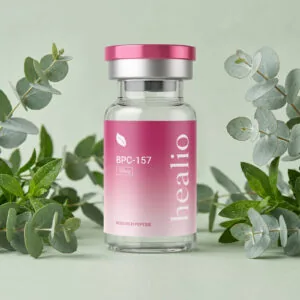 BPC-157
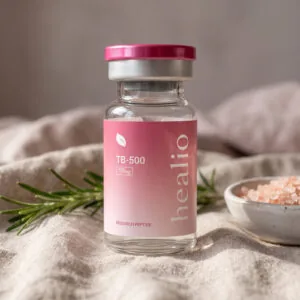 TB-500
BPC-157 vs TB-500: what is the difference?
BPC-157 is a 15 amino acid peptide derived from a protein found in gastric juice, studied mostly for blood vessel formation and growth factor signaling. TB-500 is a synthetic fragment of thymosin beta-4, studied mostly for actin binding and cell migration. Both sit almost entirely in animal and cell research, and neither is approved as a drug.
Plenty of sources call BPC-157 the local peptide and TB-500 the systemic one. It’s handy shorthand, and it is only shorthand. The papers describe mechanisms, and the territory part is something people added later. A construction site is a fairer picture: BPC-157 research reads like a study of the supply routes, with new vessels and growth signals, while TB-500 research reads like a study of the work crew, with cells changing shape and getting into position. Repair needs both, which is why people keep arguing about pairing them.
BPC-157 vs TB-500 side by side
Search it as BPC-157 vs TB-500 or TB-500 vs BPC-157 and the table is the same. It holds the facts that rarely change, plus price, size and batch data pulled live from the product and certificate pages.
| BPC-157 | TB-500 | |
|---|---|---|
| Origin | 15 amino acids, derived from a protein in human gastric juice | Synthetic fragment of thymosin beta-4, a protein found in many cell types |
| Main mechanism studied | Blood vessel formation, growth factor signaling | Actin binding, cell migration |
| Often described as | The local, site-specific peptide | The systemic, whole-body peptide |
| Strongest research area | Tendon, ligament, muscle and gut lining models | Soft tissue repair and cell migration models |
| Evidence type | Almost all preclinical | Mostly preclinical under the TB-500 name |
| Size at Healio Peptides | 10mg | 10mg |
| Price per vial | $59.99 | $74.99 |
| Latest batch purity (HPLC) | 99.5% | 99.1% |
| Certificate | BPC-157 COA | TB-500 COA |
What BPC-157 is and what its research covers
BPC-157 stands for Body Protection Compound 157. Its home turf in the literature is repair: tendon, ligament, muscle, bone and the gut lining, in animal and cell models.
The most useful single source is a 2025 systematic review in HSS Journal by Vasireddi and colleagues. They found 544 articles dating back to 1993 and kept 36. Thirty-five were preclinical. One was a clinical study, a small retrospective report. The reviewers described a consistent picture in animals: more growth hormone receptor expression, activity in pathways tied to cell growth and angiogenesis, and lower inflammatory cytokines. It is also an animal picture, and the review says so. For the mechanism in plain language, see what BPC-157 does in research.
TB-500 vs thymosin beta-4 (TB4): why the name causes confusion
TB-500 is sold as a synthetic version of thymosin beta-4, a protein that does heavy work in actin regulation. Actin is the scaffolding that lets a cell change shape and move, which is why TB-500 research clusters around cell migration and soft tissue repair models.
Here’s the wrinkle. TB-500 is a fragment of thymosin beta-4, the active region of the larger 43 amino acid protein, and it isn’t the protein itself. That gap is why “TB-500 vs TB4” gets asked at all. A 2010 review in The FASEB Journal by Sosne, Qiu and Goldstein explains where the fragment idea comes from: thymosin beta-4’s activities have been mapped to short active sites. Whether the fragment behaves like the parent protein is the assumption the compound rests on. (Thymosin alpha-1, for what it’s worth, is a different thymosin altogether.)
The trial record adds a second problem. The human studies cited for TB-500 were run on full-length thymosin beta-4, usually as eye drops. A 2015 phase 2 trial in Cornea enrolled nine patients with severe dry eye. It’s a real trial of a related molecule in a different tissue, so it tells you little about TB-500 in a tendon. The thymosin beta-4 parent protein and TB-500 research benefits pages separate what belongs to which.
BPC-157 and TB-500 stack vs blend: where they overlap
Both compounds appear in tendon, ligament and muscle repair models, and both are linked to angiogenesis and inflammation in the papers. That overlap is real. The pairing argument rests on where they differ: if one acts on supply and the other on movement, together they might cover more of the repair process. It’s a tidy theory. The combination itself has little direct testing, and the BPC-157 and TB-500 pairing covers the reasoning and the gaps.
Two words get used interchangeably online and shouldn’t be. A stack is two separate vials. A blend is one vial holding both. Healio Peptides lists the stack as two products, BPC-157 for sale and TB-500 for sale. The blends are GLOW 70, which puts 10mg of BPC-157 and 10mg of TB-500 alongside 50mg of GHK-Cu, and KLOW 80, which adds 10mg of KPV to the BPC-157, TB-500 and GHK-Cu. The informal name for the two-compound pair is the Wolverine stack, so BPC-157 vs the Wolverine stack is one compound against that pair. Whether the pair does anything together that it doesn’t do alone is, as far as the published literature goes, still open.
BPC-157 vs KPV, GHK-Cu and KLOW: the other comparisons
These searches come up beside the main one. KPV is a three amino acid fragment of alpha-MSH studied for inflammatory signaling in gut and skin models, so BPC-157 vs KPV is a broad repair literature set against a narrow signaling one, and the same goes for KPV vs TB-500. KPV for sale is its own listing. GHK-Cu is a copper-binding tripeptide studied for collagen and skin work, a different job from either compound here, and GHK-Cu for sale covers it. Comparing BPC-157 with the KLOW blend, or the GLOW blend with BPC-157, is really single compound against multi-compound vial: each blend holds the same 10mg of BPC-157 plus the others. Each of these has its own page: BPC-157 vs KPV, BPC-157 vs GHK-Cu, BPC-157 vs KLOW and BPC-157 vs GLOW.
What the BPC-157 and TB-500 studies can’t tell you
Preclinical means cells and animals. A rat tendon heals on a rat timeline, with an injury made on purpose and measured by instruments no clinic would use. Those results are worth having, and they sit a long way from a human tendon. Studies use different routes and schedules, groups are small, and a lot of the BPC-157 literature comes from a handful of laboratories, which is a reason to want independent replication. The single clinical BPC-157 study in the HSS review was a small retrospective report.
BPC-157 vs TB-500 research in women
Most of the tissue repair literature was built on male animals, and the BPC-157 papers follow that pattern. Where female animals were included, results weren’t always broken out by sex. Connective tissue and repair timelines show documented sex differences, which makes the gap more than a formality. TB-500 has the same problem and a thinner paper trail under its own name. Neither compound has the sex-stratified data a woman reading this would want. The BPC-157 research gap in women goes through it, and peptides for recovery shows how widespread the pattern is.
BPC-157 and TB-500 COA: what a lab report shows
Every Healio Peptides batch is tested by an independent US laboratory before release, and the report is published before you order. These are the current two.
| BPC-157 | TB-500 | |
|---|---|---|
| Batch | HEALIO-BPC157-2605 | HEALIO-TB500-2612 |
| Purity (HPLC) | 99.5% | 99.1% |
| Identity (ESI-MS) | Confirmed, conforms to the reference standard (1419.56) | Confirmed, conforms to the reference standard |
| Endotoxins (LAL) | Under 0.5 EU/mg (limit 5 EU/mg) | Under 0.5 EU/mg (limit 5 EU/mg) |
Purity says how clean the powder is. Identity says it’s the molecule on the label, and for TB-500 it is worth reading closely, since the name is used loosely online. Match the batch and lot numbers to the vial, then open the full reports linked in the first table. If certificates are new to you, reading a peptide certificate of analysis walks through every line.
BPC-157 vs TB-500 price and format
Healio Peptides lists BPC-157 as a 10mg vial and TB-500 as a 10mg vial, both lyophilized powder. At the listed prices BPC-157 comes to $6.00 per mg and TB-500 to $7.50 per mg, which is a rough guide at best. Questions like 5mg vs 10mg are about vial strength, and the BPC-157 calculator and TB-500 calculator show what each strength does to concentration. Both reconstitute with bacteriostatic water for sale, added slowly down the vial wall with no shaking, and how to reconstitute peptides covers the handling.
Where to buy BPC-157 and TB-500 for research
Whichever BPC-157 and TB-500 supplier you use, look for a published certificate before anything else. Every Healio Peptides batch ships with a third-party certificate, and orders go out from the United States. For a study built around the pair, start with the BPC-157 listing and the TB-500 listing. Both carry the certificate before you order.
BPC-157 vs TB-500: frequently asked questions
Is BPC-157 or TB-500 better?
Neither wins on the evidence. They’re studied for different mechanisms, and both sit mostly in animal and cell research. Which fits depends on the question a study asks, not on a ranking. Anyone naming a clear winner is going past the published data.
Can BPC-157 and TB-500 be studied together?
Researchers pair them because the mechanisms look complementary, but direct testing of the combination is thin. The pair can be sourced as two vials, or inside GLOW 70 and KLOW 80 for laboratory work, as the stack vs blend section above explains.
Is TB-500 the same as thymosin beta-4?
Related, not identical. Thymosin beta-4 is the 43 amino acid parent protein, and TB-500 is a synthetic fragment of it. The thymosin beta-4 explainer goes deeper. Human trials cited for TB-500 used the full protein.
Are BPC-157 and TB-500 FDA approved, and is there human safety data?
Neither is approved as a drug for human use, and both are prohibited in competitive sport. Human safety data is thin: the 2025 HSS review found one small clinical study of BPC-157. Healio Peptides sells both for laboratory research only, and nothing on this page is medical advice.
Where do BPC-157 and TB-500 reviews fit?
BPC-157 and TB-500 reviews mix different products, sources and expectations, so they say little about any one vial. A batch certificate says more: it ties a purity and identity result to a lot number you can check.
Which has more published research, BPC-157 or TB-500?
A clean count isn’t possible. The 2025 review kept 36 BPC-157 studies out of 544 articles, within an orthopedic scope. Much of what gets cited for TB-500 is thymosin beta-4 research under another name, so a count under the TB-500 label would mislead.
More on BPC-157 and TB-500
- Peptides for healing tendons, how to read the tendon data carefully.
- The best peptides for healing, and what each was studied for.
- Peptide stacks for women, which compounds the term usually means.
Healio Peptides supplies research compounds for laboratory use only. They are not for human or veterinary use, have not been evaluated by the FDA, and nothing on this page is medical advice.