
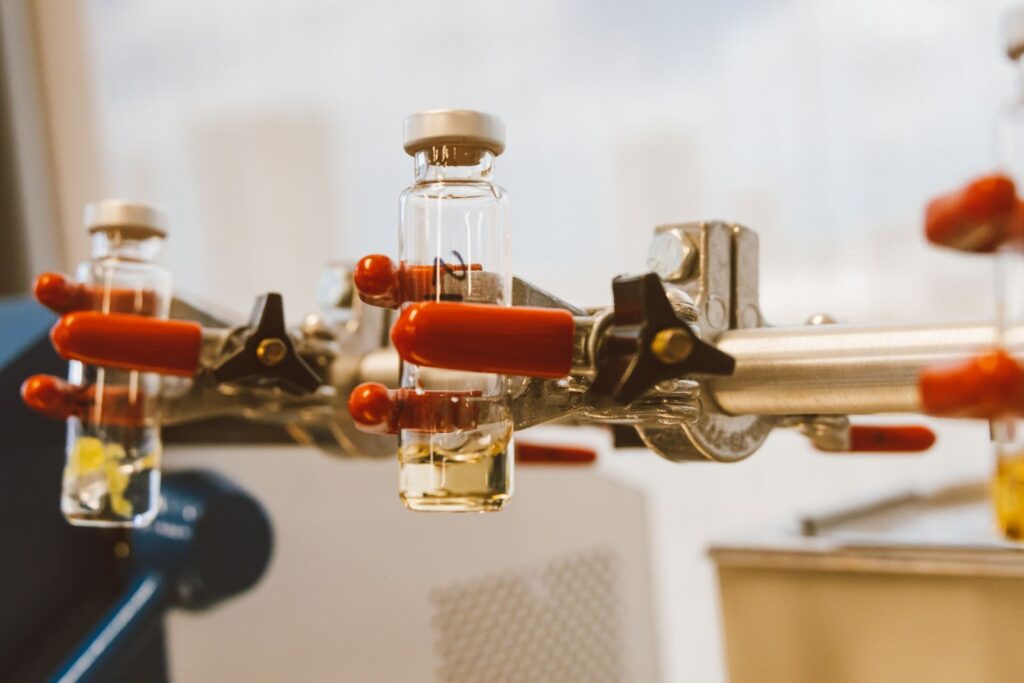
KLOW 80 is a four-peptide research blend supplied as a single 80mg vial: 50mg GHK-Cu, 10mg BPC-157, 10mg TB-500 and 10mg KPV. The name is the composition rather than a claim, and the fourth compound is what distinguishes it.
That addition is not incidental. KPV is the only component in the blend whose primary research interest is suppressing inflammation rather than driving repair, which changes what the formulation is oriented around. This guide covers what is in the vial, what each component is studied for, why the inflammation arm matters, the limits of blend-level evidence, and the reconstitution arithmetic for a four-compound vial. Nothing here is guidance for personal use.
What is in the KLOW peptide blend
The composition is disclosed rather than proprietary, which is the precondition for being able to work with it at all.
| Compound | Amount | Research focus |
|---|---|---|
| GHK-Cu | 50 mg | Collagen and elastin synthesis, extracellular matrix remodeling |
| BPC-157 | 10 mg | Angiogenesis and connective tissue repair signalling |
| TB-500 | 10 mg | Actin polymerisation and cell migration |
| KPV | 10 mg | Anti-inflammatory signalling |
Eighty milligrams in total. The first three are the GLOW 70 composition, and KPV is the addition that produces KLOW 80.
KLOW peptide benefits: what KPV adds to the stack
The fourth compound is the whole point of the formulation, so it deserves proper explanation.
KPV is a tripeptide of lysine, proline and valine, and it is the terminal fragment of alpha-melanocyte-stimulating hormone. The parent hormone has broad activity across several systems.
The fragment retains the anti-inflammatory portion of that activity without the pigmentation signalling the full molecule carries. That is why researchers study the three residues rather than the whole hormone: it isolates one property from a molecule that does several things.
The KPV research record, like the rest of this blend, is preclinical.
Why an inflammation arm changes the formulation
This is the conceptual difference between the two blends and it is worth understanding rather than treating as an upgrade.
Tissue repair proceeds through phases. An inflammatory response opens the process, clearing damaged material and recruiting the cells that build new tissue. A proliferative phase follows, and a remodeling phase reorganises the result.
GLOW 70’s three components are all studied around the building side of that process: structure, blood supply and cell migration. KLOW 80 adds a component studied around the opening phase.
The rationale is that inflammation is frequently the factor limiting repair in the models these compounds are studied in. An excessive or prolonged inflammatory phase can impede what follows, so modulating it is a plausible way to support the rest.
Worth stating precisely: the research question is modulation rather than elimination. Suppressing inflammation entirely would remove the phase that organises everything after it, which is why describing any of this as simply anti-inflammatory is imprecise. The inflammation research turns on that distinction.
What the klow stack peptide benefits research actually contains
The honest position, stated before the enthusiasm.
Each of the four components has its own research literature. GHK-Cu has decades of mechanistic work behind it. BPC-157, TB-500 and KPV all have preclinical animal and cell model research behind them.
What does not exist is published research on these four compounds administered together. Whether adding KPV to the other three produces a better outcome than the three alone has not been tested.
A blend inherits its components’ evidence and gains none of its own from the combination. Interactions can be additive, redundant or antagonistic, and a coherent rationale does not guarantee the first. What stacking assumes is rarely stated out loud.
So KLOW 80 is four individually researched compounds in one vial, combined on reasoning that is mechanistically sensible and untested at the blend level.
Why GHK-Cu carries most of the KLOW peptide mass
The 50mg to 10mg to 10mg to 10mg weighting reflects how these compounds appear in research rather than a ranking of importance.
GHK-Cu is studied at substantially higher quantities than the other three, which is a property of the compound and its literature. Mass in a vial is not a measure of potency, and different compounds are simply studied at different scales.
The copper peptide also has the longest research history of the four, examined since it was isolated from human plasma decades ago. The GHK-Cu evidence base lays out that work and its boundaries.
What the weighting does not mean is that this is a GHK-Cu product with three additives. Each component sits at a quantity consistent with its own research context, which is the only defensible basis for composing a blend.
Reconstituting a four-compound blend
The arithmetic gets more involved with each component, and the shortcut is wrong in the same way it is for any blend.
One vial reconstituted with a given solvent volume produces one solution containing four compounds at four concentrations. Each component’s concentration is its own mass divided by the same volume.
Reconstitute KLOW 80 with 2mL and you have GHK-Cu at 25 mg/mL, and BPC-157, TB-500 and KPV each at 5 mg/mL. One vial, four figures.
Dividing the 80mg total by four produces a number describing nothing. A peptide calculator handles the per-component arithmetic, and the peptide reconstitution procedure is unchanged.
Label the vial with all four concentrations at reconstitution. Reconstructing them afterwards from a partly used vial is impossible.
Storing a four-compound blend
More components means more stability profiles sharing one set of conditions.
The four sequences do not necessarily degrade at the same rate in solution, and all four sit in identical storage regardless. The vial as a whole is governed by whichever component degrades first.
That makes a blend’s usable window shorter than any single component would suggest, and it is not something to extend on the reasoning that most of the contents are probably fine. Storage conditions and labelling discipline both matter more with a blend.
KLOW peptide vs GLOW peptide
The comparison people are usually running when they land here.
GLOW 70 is 70mg across three compounds, all studied around building and repairing. KLOW 80 is those same three plus 10mg of KPV, studied around inflammatory signalling.
GLOW 70 is a repair formulation. KLOW 80 is a repair formulation with an inflammation arm. That is the entire difference, and it is a difference in orientation rather than in strength.
Neither is a stronger version of the other. The additional 10mg is a fourth compound doing a different job, not more of the first three. How the tissue repair phases separate explains the fourth compound.
Why KPV is a fragment rather than the whole hormone
The decision to study three residues instead of the parent molecule is a good illustration of how peptide research narrows a target, and it explains why KPV exists as a compound at all.
Alpha-melanocyte-stimulating hormone is a larger peptide with activity across several systems. It participates in pigmentation signalling, and it has documented anti-inflammatory activity, and it interacts with receptors involved in other processes besides.
A molecule doing several things at once is difficult to study and difficult to use as a research tool, because any observed effect could be arriving through any of its activities. Isolating one property means finding the part of the molecule responsible for it.
KPV is that isolation. The terminal three residues retain the anti-inflammatory portion of the parent hormone’s activity without carrying the pigmentation signalling, which makes it a cleaner research object than the full molecule.
This is the same logic that produced several compounds in this catalog. TB-500 relates to a fragment of a larger protein, and BPC-157 is a partial sequence identified within a larger protein found in gastric juice. Thymosin beta-4 is the parent molecule behind TB-500, and the two are not interchangeable.
What the four-compound rationale assumes
Worth making the assumptions explicit, since they are usually left implicit.
That the phases are separable in practice. Repair phases overlap rather than running in sequence, so addressing them with separate compounds assumes a cleaner separation than the biology has.
That the compounds do not interfere. Four molecules in one solution acting on overlapping pathways could be additive, redundant or antagonistic. Nothing about the rationale guarantees the first.
That the ratio is right. The 50:10:10:10 weighting follows each compound’s own research context, which is defensible and is not a tested combination ratio.
That inflammation is limiting in the relevant context. The case for adding KPV rests on inflammation being what constrains repair, which is true in some models and not universally.
None of these assumptions are unreasonable. All of them are assumptions, and a formulation built on four of them stacked together carries more uncertainty than any single component does. The phase model is where all four assumptions meet.
Sourcing and verifying a KLOW peptide blend
A four-compound vial raises the verification bar, because there are four sequences to confirm rather than one.
The standard is a batch-specific certificate of analysis from a named independent laboratory, with purity by HPLC and identity by mass spectrometry, and a lot number matching the vial. For a blend, documentation should address the components rather than reporting one undifferentiated figure.
Reading what a certificate of analysis shows is the skill, knowing what to demand of a supplier is the application, and every batch Healio ships is independently tested before it leaves.
KLOW peptide benefits: frequently asked questions
What is the klow peptide blend?
KLOW 80 is a four-peptide research blend in one 80mg vial: 50mg GHK-Cu, 10mg BPC-157, 10mg TB-500 and 10mg KPV. The composition is disclosed rather than proprietary.
What is in the klow peptide stack?
Four compounds. Three studied around tissue repair, remodeling, blood supply and cell migration, plus KPV, which is studied around inflammatory signalling rather than repair.
What are the klow stack peptide benefits reported in research?
Each component has its own preclinical literature, and none of it examines the four administered together as a blend.
What does KPV add?
KPV is the terminal fragment of alpha-melanocyte-stimulating hormone, retaining the anti-inflammatory portion of that hormone’s activity without its pigmentation signalling. It is the only component studied around inflammation rather than repair.
What is the difference between KLOW 80 and GLOW 70?
KLOW 80 is GLOW 70 plus 10mg of KPV. GLOW 70 is a repair formulation; KLOW 80 is a repair formulation with an inflammation arm. It is a difference in orientation, not strength.
How do you calculate concentration for KLOW 80?
Each component separately against the same solvent volume. Reconstituted with 2mL, GHK-Cu is at 25 mg/mL and the other three at 5 mg/mL each. Dividing the 80mg total by four is not valid.
Does the blend have its own research?
No. Whether adding KPV to the other three produces a better outcome than the three alone has not been tested. A blend inherits component evidence and gains none from the combination itself.
Why is GHK-Cu 50mg of the 80mg?
Because it appears in research at substantially higher quantities than the other three. That reflects each compound’s own research context rather than a ranking, and mass is not a measure of potency.
Four compounds, one untested combination
KLOW 80 is what its composition says: four compounds with independent research records, weighted as their own literatures suggest, combined on reasoning about repair phases that has not been tested as a combination. The inflammation arm is a genuine difference in what the formulation targets rather than a bigger version of the three-compound blend. The skin and beauty collection and healing collection hold the blend and its components, every batch independently tested before it ships.
Related reading
- GLOW 70, the three-compound version without the inflammation arm.
- KPV Peptide Benefits, the compound that distinguishes this blend.
- Peptides for Inflammation, why modulation is the research question.
- Peptide Stacks for Women, what combining compounds assumes.
KLOW peptide side effects: what the studies does and does not cover
No study has administered these four compounds together, so no adverse event profile exists for the KLOW peptide blend. Everything available is the separate safety evidence base on GHK-Cu, BPC-157, TB-500 and KPV, and three of those four are thin in humans.
KPV is the newest arrival of the group and the one with the least published tolerability work behind it. It is a fragment of alpha-MSH, studied mainly in models of intestinal and skin inflammation, and its short peptide chain is part of why researchers find it interesting. Short does not mean well characterised.
Adding a fourth compound to a three-compound blend adds a fourth mechanism and a fourth set of unknowns. It does not average out the uncertainty, and any vendor implying that a bigger blend is a safer one has the logic backwards. Supplied for laboratory research only.
Wider context: peptide side effects, are peptides safe and KPV peptide benefits.