
Ask someone which research peptide is for repair and you’ll often hear two answers in the same sentence: BPC-157 and GHK-Cu. They get lumped together as “healing peptides,” and the label hides a real difference in what each has been studied to do. BPC-157 comes from a protein in gastric juice and is studied mostly in tendon, ligament, muscle and gut lining models. GHK-Cu is a copper-binding tripeptide studied mostly for skin remodeling, collagen and elastin. This BPC-157 vs GHK-Cu comparison covers what each compound is, what the research behind them covers, where they overlap, and what a batch lab report shows. Everything below describes laboratory research. Listings are linked as we go, and the peptides for healing category shows where each fits.
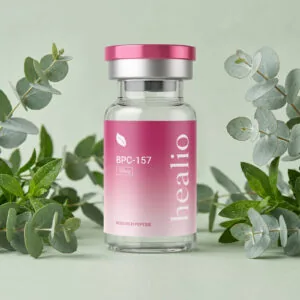 BPC-157
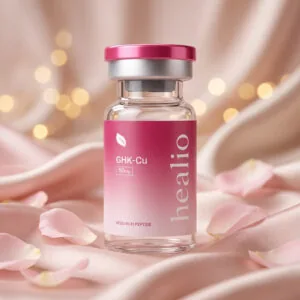 GHK-Cu
BPC-157 vs GHK-Cu: what is the difference?
BPC-157 is a 15 amino acid peptide with a sequence derived from a gastric protein. GHK-Cu is glycyl-histidyl-lysine, three amino acids, bound to a copper(II) ion. BPC-157 research reads like a study of repair supply: new blood vessels, growth factor signaling, tendon and gut models. GHK-Cu research reads like a study of tissue remodeling: collagen, elastin, skin and wound models. Both are mostly laboratory work, and neither is approved as a drug. One older answer on a popular forum puts the split as local versus systemic. It’s a handy shorthand with little to back it, because the papers describe mechanisms and leave the territory out.
BPC-157 vs GHK-Cu side by side
The table holds the facts that rarely change, plus size, price and batch data pulled live from the product and certificate pages. Searching ghk cu vs bpc 157 gives the same two columns.
| BPC-157 | GHK-Cu | |
|---|---|---|
| Origin | 15 amino acids, derived from a protein in human gastric juice | Tripeptide bound to copper, found naturally, identified in 1973 |
| Main mechanism studied | Blood vessel formation, growth factor signaling | Collagen and elastin signaling, tissue remodeling |
| Strongest research area | Tendon, ligament, muscle and gut lining models | Skin remodeling, wound and tissue repair models |
| Evidence type | Almost all preclinical | Mostly laboratory research, with a longer record |
| Size at Healio Peptides | 10mg | 50mg and 100mg |
| Price per vial | $59.99 | from $34.99 |
| Latest batch purity (HPLC) | 99.5% | 99.4% |
| Certificate | BPC-157 COA | GHK-Cu COA |
What BPC-157 is and what its research covers
The most useful single source is a 2025 systematic review in HSS Journal by Vasireddi and colleagues. They found 544 articles dating back to 1993 and kept 36. Thirty-five were preclinical and one was a small retrospective clinical report. The reviewers described a consistent animal picture: activity in pathways tied to cell growth and angiogenesis, and lower inflammatory cytokines. Read it as a strong animal signal from a small set of laboratories. For the mechanism in plain language, see what BPC-157 does in research.
What GHK-Cu is and what its research covers
GHK-Cu has the longer paper trail. Two reviews give the clearest overview. The human tri-peptide GHK and tissue remodeling, published in the Journal of Biomaterials Science in 2008, sets out the peptide’s role in remodeling tissue. A 2018 review in the International Journal of Molecular Sciences revisited its regenerative and protective actions against newer gene expression data. Both list Pickart first, which is worth keeping in mind when a literature leans on a small group of authors. GHK-Cu peptide benefits covers the findings, and copper peptides covers the history.
Size and structure: 15 amino acids against three plus copper
The molecules couldn’t look less alike. BPC-157 is a 15 amino acid chain, an unusual stable fragment in that it survives in acid, which is part of why the gut work exists. GHK-Cu is only three amino acids, glycine, histidine and lysine, but it binds a copper ion, and the copper is part of the story: the reviews treat the copper-bound form as the active research compound. That affects handling and checking. A tripeptide with a metal ion needs an identity check that confirms the copper-bound mass, and a 15 amino acid chain needs one that confirms the sequence. The certificates below show each.
BPC-157 vs GHK-Cu for skin and tissue repair
This is where the two compounds get compared most often, and where they genuinely overlap. Both have been studied in wound and tissue repair models. The difference is emphasis. GHK-Cu’s literature centers on skin: collagen production, elastin, the extracellular matrix. BPC-157’s literature centers on musculoskeletal and gut tissue, with angiogenesis as the recurring theme. A study of skin remodeling points at GHK-Cu. A study of tendon or lining repair points at BPC-157. A study of wound closure could reasonably involve either, and the two have rarely been tested side by side, so the choice there comes down to the model. The best peptides for skin guide and peptides for healing tendons show each in its own territory.
When BPC-157 alone, GHK-Cu alone, or both
A study of tendon, ligament or gut repair maps onto BPC-157, and a study of skin remodeling or collagen maps onto GHK-Cu. A design that spans both, such as a full-thickness wound model that looks at vessel growth and matrix remodeling, could use the two together. The careful version still includes single-compound arms, since an effect in the combined group can’t tell you which compound produced it. Because Healio Peptides lists them separately, a study sets its own ratio and can add the second compound later without redoing earlier work.
BPC-157 vs GHK-Cu research for women
Skin is the research area that most often brings women to GHK-Cu, and the copper peptide has the more direct record there. BPC-157’s skin evidence is wound-healing work in animals. For a question about skin remodeling, the single GHK-Cu vial is the closer match. For a question about connective tissue repair, BPC-157 is, with the caveat that most of that work used male animals and sex-stratified results are rare. The peptide stacks for women guide covers which gaps matter.
BPC-157 and GHK-Cu together: where GLOW fits
They’re two listings, BPC-157 for sale and GHK-Cu for sale. Both are also inside GLOW 70, which holds 50mg of GHK-Cu, 10mg of BPC-157 and 10mg of TB-500. The BPC-157 vs GLOW page covers that blend from the BPC-157 side, and GHK-Cu vs GLOW covers it from the copper peptide side.
What the BPC-157 and GHK-Cu studies can’t tell you
The repair claims for both compounds come from models that don’t match a human injury: an induced wound in a rodent, a transected tendon, cultured cells. Results from one model rarely transfer cleanly to another, and almost none of this work has been run on human tissue under controlled conditions. Both literatures also rest on a limited set of laboratories, which makes independent replication valuable. There is a sex gap too. Much of the repair research used male animals, and repair timelines show documented sex differences. A woman reading these papers to frame her own research question should treat the sex-stratified evidence as missing. The BPC-157 research gap in women goes through it.
BPC-157 and GHK-Cu COA: what a lab report shows
Every Healio Peptides batch is tested by an independent US laboratory before release, and the report is published before you order. These are the current two.
| BPC-157 | GHK-Cu | |
|---|---|---|
| Batch | HEALIO-BPC157-2605 | HEALIO-GHKCU01 |
| Purity (HPLC) | 99.5% | 99.4% |
| Identity (ESI-MS) | Confirmed, conforms to the reference standard (1419.56) | Confirmed, conforms to the reference standard (403.93) |
| Endotoxins (LAL) | Under 0.5 EU/mg (limit 5 EU/mg) | Under 0.05 EU/mg (limit 5 EU/mg) |
Identity is the line to read for a copper compound. The mass in parentheses on the GHK-Cu report is the copper-bound molecule’s, which is the figure a reference standard check should match. Match the batch and lot numbers to the vial. If certificates are new to you, reading a peptide certificate of analysis walks through every row.
BPC-157 vs GHK-Cu price and format
Healio Peptides lists BPC-157 as a 10mg vial and GHK-Cu in 50mg and 100mg vials, all lyophilized powder. Questions like 5mg vs 10mg or 50mg vs 100mg are about vial strength, and the BPC-157 calculator and GHK-Cu calculator show what each strength does to concentration after reconstitution. Both dissolve in bacteriostatic water for sale, added slowly down the vial wall with no shaking. The two vials at their lowest listed sizes come to $94.98, and how to reconstitute peptides covers the handling.
Where to buy BPC-157 and GHK-Cu for research
With either compound, look for a published certificate before anything else. Every Healio Peptides batch ships with a third-party report, and orders go out from the United States. The tissue repair compound is the BPC-157 listing, and the copper peptide is the GHK-Cu listing.
BPC-157 vs GHK-Cu: frequently asked questions
Is BPC-157 or GHK-Cu better?
Neither wins on the evidence. They’re studied for different mechanisms in different tissues, and both sit mostly in laboratory research. Which fits depends on the question a study asks.
Can BPC-157 and GHK-Cu be studied together?
Researchers combine them because the mechanisms look complementary, but direct testing of the pair is thin. They can be sourced as two vials, or inside GLOW 70 alongside TB-500.
What is the difference between BPC-157 and GHK-Cu?
BPC-157 is a 15 amino acid peptide studied for blood vessel formation and musculoskeletal repair. GHK-Cu is a copper-bound tripeptide studied for skin remodeling and collagen signaling.
Which has more published research?
GHK-Cu has the longer history, with a peptide identified in 1973 and reviews spanning decades. BPC-157 has a large volume of animal work from fewer laboratories. A clean count isn’t possible, and the 2025 review kept only 36 BPC-157 studies from 544 articles within an orthopedic scope.
Are BPC-157 and GHK-Cu FDA approved?
Neither is approved as a drug for human use, and nothing on this page is medical advice. Healio Peptides sells both strictly for laboratory research.
Where do BPC-157 and GHK-Cu reviews fit?
BPC-157 and GHK-Cu reviews mix different products, sources and expectations, so they say little about any one vial. A batch certificate ties a purity and identity result to a lot number you can check.
More on BPC-157 and GHK-Cu
- BPC-157 vs TB-500, the pairing people search most.
- Anti-aging peptides, the wider category GHK-Cu sits in.
- BPC-157 vs KPV, repair against inflammatory signaling.
Healio Peptides supplies research compounds for laboratory use only. They are not for human or veterinary use, have not been evaluated by the FDA, and nothing on this page is medical advice.