
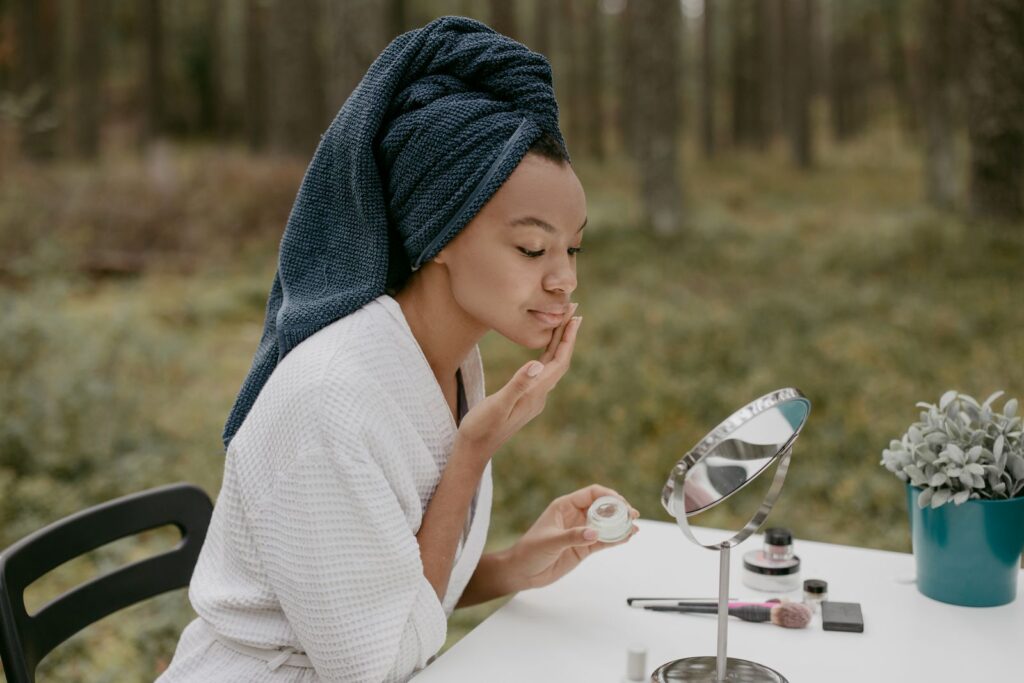
Peptide skincare is now a category unto itself, and the word peptide on a bottle has become roughly as informative as the word natural. It appears on products ranging from genuinely well formulated to essentially decorative, and the label alone does not distinguish them.
The underlying science is real. Certain peptides have been studied in skin contexts for decades, which is a different matter from what peptides in skin care are once they are in a serum. The gap between that research and what most serums can actually deliver is the subject of this guide. It covers which peptides appear in skincare, what the research examined, the barrier problem that governs everything, how cosmetic and research grade differ, and how to read a peptide skincare label with some skepticism. Nothing here is guidance for personal use.
What peptide skincare actually is
A peptide skincare product is a cosmetic formulation containing one or more peptides as active ingredients, applied topically and regulated as a cosmetic.
That regulatory position matters more than it sounds. Cosmetics are regulated for safety and labelling, not for efficacy. A product does not have to demonstrate that it works to be sold, and it does have to avoid claiming it treats anything, which is why cosmetic copy lives in the vocabulary of appearance rather than effect.
The peptides themselves are usually present at low concentration, in a formulation designed around stability, feel and shelf life alongside whatever the active is meant to do. The peptide definition explains the molecule; the product is the molecule plus a great deal of formulation engineering.
Which peptides appear in skincare
A handful of names recur across the market, and they do different things.
Copper peptides. Almost always GHK-Cu, a tripeptide bound to copper, and the most substantially researched of the group. Copper peptide research goes back decades.
Signal peptides. Sequences proposed to influence the production of structural proteins in skin. Marketed heavily around collagen language, which is a separate question from peptides.
Carrier peptides. Sequences that deliver trace elements, which overlaps with what GHK-Cu does with copper.
Neurotransmitter-inhibiting peptides. Marketed with comparisons to injectable treatments, which is a comparison worth treating with considerable caution given the difference in delivery.
The research depth across these four is wildly uneven. GHK-Cu has decades of published mechanistic work. Others have considerably less, and some have primarily manufacturer-sponsored testing. The best researched skin peptides sort out unevenly once ranked by evidence.
Peptide skincare and the skin barrier problem
Everything in this category runs into one obstacle, and honest discussion of peptide skincare has to start here.
Skin exists to keep things out. The outermost layer is a genuine barrier built from dead cells and lipids, and it is very effective. Molecular size is a primary determinant of what crosses it, and the rough working threshold used in formulation science excludes a great deal of what gets marketed as topically active.
Peptides are large relative to that threshold. GHK-Cu is a tripeptide, which makes it small for a peptide, and that smallness is a substantial part of why it is the one that gets studied rather than a larger candidate.
So a peptide serum faces a specific question that marketing rarely engages with: how much of the active reaches the cells carrying the receptors it is meant to signal? A compound that cannot get there produces no effect no matter how well characterized its mechanism is in a dish.
Formulation science exists to address exactly this, through delivery systems, penetration enhancers and molecular modification. That work is real and difficult. A product that names an impressive peptide without addressing delivery has skipped the hard part.
What the peptide skin research actually measured
The literature is more specific than the marketing derived from it, and the specifics are where the overstatement happens.
The strongest body of work concerns GHK-Cu in wound repair contexts, examining tissue remodeling processes. That is where the mechanism was characterized, and wound repair is not the same setting as cosmetic application to intact skin. Damaged skin has no intact barrier, which removes the delivery problem entirely and makes those findings poor evidence for topical cosmetic use.
Gene expression studies reporting that GHK influences the expression of large numbers of genes get cited constantly. Influencing expression is not the same as producing a beneficial outcome, and the direction of every change is not uniformly favorable. A large number is not a good number by default.
Studies in cosmetic formulation contexts exist and are frequently small, short, and sponsored by the manufacturer of the product under test. That does not make them worthless. It does mean they occupy a different evidential position from independent controlled work. The GHK-Cu evidence base goes through the distinction.
Cosmetic peptides versus research grade peptides
This distinction resolves most of the confusion in this category, and it runs deeper than concentration.
| Cosmetic peptide | Research grade peptide | |
|---|---|---|
| Form | Formulated serum or cream | Lyophilized powder |
| Regulation | Cosmetic framework | Research use only, not evaluated for human use |
| Testing standard | Cosmetic safety and stability | Identity and purity by HPLC and mass spectrometry |
| Intended use | Topical application for appearance | Laboratory work |
The molecule can be the same in both columns. Nothing else is. The research grade standard lays out what that standard certifies, and it is not a stronger version of the cosmetic product.
The error that matters most: treating a research vial as a concentrated serum. It is not formulated for topical use, has not been evaluated for it, and the delivery problem that formulation exists to solve has not been solved for it. A powder is not a skincare product.
How to read a peptide skincare label
Ingredient lists are ordered by concentration down to one percent, after which order is arbitrary. That single fact does most of the work here.
A peptide appearing near the end of a long list is present at low concentration, whatever the front of the bottle says. Peptides are expensive, which creates a persistent incentive to include enough to name and not enough to matter.
Look for the peptide named specifically rather than as peptide complex or peptide blend, which are not ingredients. Look for whether the brand states a concentration, which most do not. And treat before-and-after imagery as marketing rather than data, because that is what it is.
The ingredient vocabulary on a skincare label rewards a closer look than it usually gets.
Peptide skincare stability and why formulation is hard
Delivery gets the attention it deserves. Stability gets almost none, and it is the other half of why formulating with peptides is genuinely difficult.
Peptides degrade in solution. That is the same property behind peptide storage requirements for research material, and a cosmetic serum is a peptide in solution sitting on a bathroom shelf at room temperature for months, opened repeatedly, exposed to light and air.
Those are close to worst-case conditions for peptide stability. A formulation has to hold the molecule intact across that entire period, which means pH control, antioxidants, packaging that limits light and air exposure, and frequently preservative systems that do not themselves attack the active.
Copper peptides add a further complication, because the copper complex interacts with other common ingredients. Certain actives are documented as poor formulation partners for copper peptides, which is why the advice to avoid layering them with particular products circulates so widely. That advice has a chemical basis rather than being folklore.
The practical consequence for reading products: opaque, air-restricting packaging is a meaningful signal, and a clear jar is a meaningful signal in the other direction. A peptide in a wide-mouthed pot exposed to air and light every day is a peptide with a short working life regardless of what went into it at manufacture.
What peptide skincare cannot do
Worth stating directly, since the claims routinely outrun the category.
A cosmetic product acts on appearance. It does not treat a medical condition, and a product claiming to would have moved into a different regulatory category with requirements it has not met. The claims framework explains why that boundary exists, and peptides for acne shows how it applies to a diagnosable skin condition.
Comparisons to injectable procedures are marketing constructions. A topically applied cosmetic and an injected clinical treatment differ in delivery, concentration, mechanism and regulatory status. The comparison survives only by ignoring all four.
And no cosmetic peptide has the evidence base of the compounds studied in clinical development. The evidence tier distinction sets out how far apart those categories sit.
Where research peptides fit for skin
Since this site supplies research compounds rather than cosmetics, the honest framing is worth stating.
GHK-Cu is supplied as a research compound for laboratory work, in 50mg and 100mg presentations. GLOW 70 and KLOW 80 are blended research formulations containing it alongside other compounds.
These are not skincare products and are not supplied as alternatives to them. They are research material, and the skin and beauty collection groups them by the research area they belong to rather than by cosmetic application.
Every batch carries independent testing published before purchase, and a certificate of analysis is what documents it.
Peptide skincare: frequently asked questions
Does peptide skincare actually work?
The mechanisms are real and the delivery problem is substantial. Skin is an effective barrier and peptides are large relative to what crosses it, so how much active reaches the target cells is the deciding question and one most marketing does not address.
Which peptides are used in skincare?
Copper peptides such as GHK-Cu, signal peptides marketed around structural protein production, carrier peptides delivering trace elements, and neurotransmitter-inhibiting peptides. Research depth across the four is very uneven, with GHK-Cu the best characterized.
What is the difference between cosmetic and research grade peptides?
Form, regulation, testing standard and intended use all differ, even where the molecule is identical. Cosmetic products are formulated and regulated as cosmetics. Research material is lyophilized powder for laboratory work, which is what research grade certifies.
Can research peptides be used as skincare?
No. Research compounds are lyophilized powder supplied for laboratory work, not formulated for topical application and not evaluated for it. The delivery engineering a cosmetic depends on has not been done for them.
How do you tell if a peptide serum has enough active in it?
Ingredient lists are ordered by concentration down to one percent, after which order is arbitrary. A peptide near the end of a long list is present at low concentration regardless of front-of-bottle claims, and most brands do not state a figure.
Are peptide serums comparable to injectable treatments?
No. The comparison requires ignoring differences in delivery, concentration, mechanism and regulatory status. A topically applied cosmetic and an injected clinical procedure are not the same category of intervention.
Why is wound healing research weak evidence for cosmetic use?
Damaged skin has no intact barrier, which removes the delivery problem entirely. Findings from wound repair contexts describe a setting where the compound reaches the tissue freely, which is not the situation on intact skin.
What does the gene expression research on GHK actually show?
That GHK influences the expression of a large number of human genes. Influencing expression is not the same as producing a beneficial outcome, and the direction of every change is not uniformly favourable. Volume of effect is not quality of effect.
Real science, oversold product category
The peptide skin research is genuine and mostly answers questions about mechanism rather than about serums. The distance between those two is where the marketing lives, and reading the category well mostly means asking how the active is supposed to get where it needs to go. The skin and beauty collection holds the research compounds discussed here, every batch independently tested before it ships.
Related reading
- Copper Peptides, the most researched compound in the category.
- Best Peptides for Skin, sorted by evidence rather than marketing.
- Peptides vs Collagen, why the collagen language is a separate conversation.
- What Research Grade Peptides Means, the standard that separates the two categories.
- Peptide reconstitution calculator, for the arithmetic behind any vial.