
The word thymosin does a lot of damage to this comparison. It suggests a family, and a reader who sees “thymosin alpha-1” and “thymosin beta-4” side by side reasonably assumes one is a variant of the other. They aren’t. Thymosin alpha-1 is a short immune-signaling peptide first isolated from thymic tissue. Thymosin beta-4 is a 43 amino acid protein found in nearly every cell, best known for binding actin, and TB-500 is the fragment of it that research suppliers sell. This TB-500 vs thymosin alpha-1 comparison covers what each one is, what the published studies actually found, including one large trial that came back flat, and what to ask of a lab report. Everything below describes laboratory research.
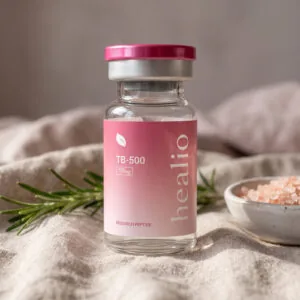 TB-500
 vs thymosin alpha-1: what is the difference?
TB-500 belongs to the thymosin beta-4 side of the research: cell migration, actin regulation, wound repair, angiogenesis. Thymosin alpha-1 belongs to the immune side: dendritic cells, cytokine signaling, and clinical trials in infection. The two share a root in the name and in the thymus and not much else. One is studied for how tissue rebuilds, and the other for how the immune system is prompted. A study that chooses between them is choosing a biological question, not a stronger molecule.
TB-500 vs thymosin alpha-1 side by side
The table holds the facts that rarely change. TB-500’s size, price and batch data are pulled live from the product and certificate pages, and the thymosin alpha-1 cells say what to ask a seller. Searched as thymosin alpha-1 vs TB500 or the other way round, the table is the same.
| TB-500 | Thymosin alpha-1 | |
|---|---|---|
| What it is | A fragment of thymosin beta-4, a 43 amino acid protein | A 28 amino acid, N-terminally acetylated peptide |
| Main area studied | Cell migration, actin binding, wound repair | Immune modulation through dendritic cells |
| Best-known human data | Clinical trials of the parent protein, reviewed in 2015 | Randomized sepsis trials, including a 2025 phase 3 |
| Size and price | 10mg vial, $74.99 | Varies by seller |
| Latest batch purity (HPLC) | 99.1% | Ask the seller for the batch report |
| Certificate | TB-500 COA | Ask the seller for the certificate |
What TB-500 is and what its research covers
Start with the protein it comes from. Sosne and colleagues in the FASEB Journal describe thymosin beta-4 as a small ubiquitous protein of 43 amino acids and the major actin-sequestering molecule in cells, with several short active sites. One of them, a sequence containing LKKTETQ, the central actin-binding domain, was linked to angiogenesis, wound healing and cell migration. Philp and colleagues in Wound Repair and Regeneration found the parent protein accelerated dermal repair in diabetic and aged mice, and that the seven amino acid LKKTETQ peptide promoted repair in the aged animals comparably. Goldstein and colleagues’ 2015 review summarizes the clinical trials of thymosin beta-4 in eye, dermal, heart and brain repair. The TB-500 research benefits page goes through the rest, and thymosin beta-4 covers the parent.
What thymosin alpha-1 is and what its research covers
Thymosin alpha-1 is reported in a manufacturing paper as a 28-amino acid Nα-acetylated peptide. King and colleagues in Vitamins and Hormones review it as a compound first isolated from thymic tissue as the factor restoring immune function in thymectomized mice, acting through Toll-like receptors on myeloid and plasmacytoid dendritic cells. Most of its clinical record is in sepsis. The Chinese ETASS trial randomized 361 ICU patients and saw 28-day mortality of 26.0 percent against 35.0 percent, a marginal result. A 2025 meta-analysis of 11 randomized trials reported a mortality reduction overall, but not in the high-quality or multicenter subgroups.
The large thymosin alpha-1 trial that found nothing
The newest and largest piece of the record is the TESTS trial in the BMJ, a double-blind, placebo-controlled phase 3 trial across 22 Chinese centres that randomized 1,106 adults with sepsis. Twenty-eight-day mortality was 23.4 percent with thymosin alpha-1 and 24.1 percent with placebo, a hazard ratio of 0.99, and the authors wrote that they found no clear evidence it decreases mortality. The prespecified subgroups hinted at differences by age and diabetes status, which the authors present as possible, not settled. It is a good example of why a comparison page should say what the studies didn’t find. A reader who stopped at the smaller 2013 trial would leave with a different picture.
TB-500 vs thymosin beta-4 vs thymosin alpha-1
Search results also ask TB-500 vs thymosin beta-4, or TB-500 vs TB4. Thymosin beta-4 is the 43 amino acid parent protein, and TB-500 is the fragment of it that suppliers sell. Papers on the whole protein, such as Goldstein’s review, describe the parent, and the fragment’s own literature is the short active-site work in Sosne and Philp. Reading across from a trial of the full protein to a fragment vial is an assumption. Thymosin alpha-1 is a separate peptide with a different job, so it shouldn’t be pulled into that comparison at all. The BPC-157 vs TB-500 page covers TB-500 against a repair peptide, where the question is closer.
When TB-500 and when thymosin alpha-1
A question about cell migration, actin dynamics or wound closure maps onto TB-500 and its parent. A question about dendritic cell activation or immune signaling maps onto thymosin alpha-1. A design that needs both would be asking whether tissue repair depends on immune tone, and no paper cited here builds that experiment. The peptides for the immune system guide gives the wider context on the immune side.
Reading social posts that pair TB-500 and thymosin alpha-1
Short videos and forum threads often pair the two for autoimmune or chronic conditions, as if one covers repair and the other covers immunity. Those posts describe a plan. They aren’t a result. None of the papers cited on this page studies TB-500 or thymosin alpha-1 in lupus or rheumatoid arthritis, and the sepsis trials involved critically ill adults in intensive care, a very different setting. When a post names a condition, ask which paper studied that condition with that compound. The honest answer for this pair is usually that the paper hasn’t been written.
TB-500 and thymosin alpha-1 in women’s research
Neither literature leads with sex-specific results. The sepsis trials enrolled adults generally, and the TESTS subgroup findings were reported by age and diabetes status. The wound repair work in mice used diabetic and aged models, and the abstracts don’t break results out by sex. A woman framing her own research question will want to check each paper’s methods for the sex of the animals or participants, since many studies of this kind don’t report it. The BPC-157 research gap in women covers the equivalent problem on the repair side.
What the TB-500 and thymosin alpha-1 studies can’t tell you
A diabetic mouse wound is not a human wound, and the 2003 mouse study doesn’t reach into the fragment sold as a vial. Thymosin alpha-1’s sepsis trials concern critically ill adults in intensive care, which says very little about a cell-culture immune assay. The meta-analysis itself reports no mortality benefit in the high-quality and multicenter subgroups, and the biggest trial was null. For both compounds, the cleanest reading is that each has a mechanism and a record, and neither record settles a head-to-head question that nobody has tested.
TB-500 COA: what a lab report shows, and what to ask for on thymosin alpha-1
Every Healio Peptides batch is tested by an independent US laboratory before release, and the report is published before you order. This is the current TB-500 batch.
| TB-500 | |
|---|---|
| Batch | HEALIO-TB500-2612 |
| Purity (HPLC) | 99.1% |
| Identity (ESI-MS) | Confirmed, conforms to the reference standard |
| Endotoxins (LAL) | Under 0.5 EU/mg (limit 5 EU/mg) |
The same four lines are what to ask for from any seller of thymosin alpha-1. N-terminal acetylation is part of the thymosin alpha-1 structure, so ask that the identity result confirms the acetylated mass and not the bare sequence. A 28 amino acid peptide also leaves more room for synthesis errors than a short one. Reading a peptide certificate of analysis explains each row.
TB-500 price and format
Healio Peptides lists TB-500 as a 10mg vial, lyophilized powder, at $74.99, which is $7.50 per mg. Thymosin alpha-1 strengths and prices vary by seller, so compare cost per milligram and not per vial. Reconstitution uses bacteriostatic water for sale, and the TB-500 calculator turns vial strength and water volume into a concentration. How to reconstitute peptides covers the handling.
Where to buy TB-500 for research
Whatever you source, look for a published certificate before anything else. Every Healio Peptides TB-500 batch ships with a third-party report, and orders go out from the United States. The TB-500 for sale page carries the certificate before you order, and the peptides for healing category shows the neighboring repair compounds.
TB-500 vs thymosin alpha-1: frequently asked questions
Is TB-500 the same as thymosin alpha-1?
No. TB-500 is a fragment of thymosin beta-4, a 43 amino acid actin-binding protein. Thymosin alpha-1 is a separate 28 amino acid peptide studied for immune signaling. They share a name root and little else.
Which has more human clinical data, TB-500 or thymosin alpha-1?
Thymosin alpha-1 has the larger randomized record, mostly in sepsis. The parent protein of TB-500 has clinical trials in tissue repair that the 2015 review summarizes, but the fragment sold as TB-500 isn’t the subject of those trials.
Did the thymosin alpha-1 sepsis trials show a benefit?
Mixed. The 2013 ETASS trial found a marginal reduction in 28-day mortality, and the 2025 TESTS phase 3 trial of 1,106 adults found no clear evidence of a difference. The meta-analysis reported benefit overall but not in the higher-quality subgroups.
What should a TB-500 or thymosin alpha-1 certificate show?
Purity by HPLC, identity by mass spectrometry, an endotoxin result and a lot number that matches the vial. For thymosin alpha-1, check that identity confirms the acetylated form.
Are TB-500 and thymosin alpha-1 FDA approved?
Nothing on this page is a statement about any product’s legal status or medical advice. Healio Peptides sells TB-500 strictly for laboratory research, and the trials described here are published studies, not guidance.
Do TB-500 and thymosin alpha-1 reviews tell me anything useful?
Reviews mix different products, forms and expectations, so they say little about any one vial. A batch certificate says more: it ties a purity and identity result to a lot number you can check.
More on TB-500 and the thymosins
- BPC-157 vs TB-500, the two repair peptides side by side.
- KLOW vs KPV, a blend that holds TB-500 set against a single compound.
- BPC-157 and TB-500, why the pair is studied together.
Healio Peptides supplies research compounds for laboratory use only. They are not for human or veterinary use, have not been evaluated by the FDA, and nothing on this page is medical advice.