
Epitalon and Pinealon come out of the same research tradition and are usually mentioned in the same breath, with the Khavinson laboratory’s name attached to both. They are also very different in what they are said to do. Epitalon is a four amino acid peptide, Ala-Glu-Asp-Gly, studied for telomerase and ageing biology. Pinealon is a three amino acid peptide, Glu-Asp-Arg, studied for protecting neurons from oxidative stress and hypoxia. This Epitalon vs Pinealon comparison covers what each one is, what the studies found, the one paper that tested both, and what a lab report should show. Everything below describes laboratory research.
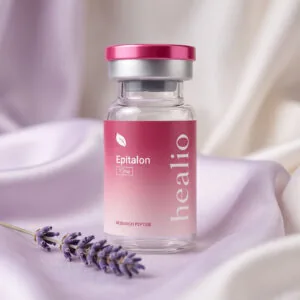 Epitalon
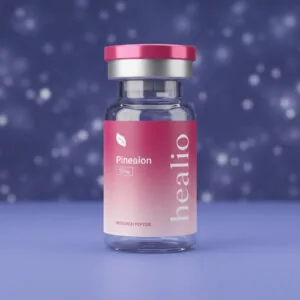 Pinealon
Epitalon vs Pinealon: what is the difference?
Epitalon’s papers ask whether a short peptide can reactivate telomerase and extend the division limit of human cells, and whether it changes lifespan in mice. Pinealon’s papers ask whether a tripeptide can limit reactive oxygen species and cell death in neurons and improve resistance to hypoxia. One is studied in the language of ageing biology, and the other in the language of neuroprotection. They share a research tradition and a method of working, with short peptides tested in cell cultures and rodents, and they share the same main limit, which is thin independent replication.
Epitalon vs Pinealon side by side
The table holds the facts that rarely change, plus size, price and batch data pulled live from the product and certificate pages. Searched as Pinealon vs Epitalon, the table is the same.
| Epitalon | Pinealon | |
|---|---|---|
| Sequence | Ala-Glu-Asp-Gly, four amino acids | Glu-Asp-Arg, three amino acids |
| Main area studied | Telomerase, telomere length, lifespan in mice | Oxidative stress, hypoxia, neuron survival |
| Main models | Human cell lines and mice | Cultured neurons and rats |
| Evidence type | Cell and rodent work, largely from one tradition | Cell and rodent work, largely from one tradition |
| Size at Healio Peptides | 10mg and 50mg | 10mg |
| Price per vial | from $59.99 | $49.99 |
| Latest batch purity (HPLC) | 99.2% | 99.2% |
| Certificate | Epitalon COA | Pinealon COA |
What Epitalon is and what its research covers
Khavinson and colleagues in Bulletin of Experimental Biology and Medicine reported that Epithalon induced telomerase expression, enzymatic activity and telomere elongation in telomerase-negative human fetal fibroblasts. A follow-up in the same journal found that treated cells with elongated telomeres made ten extra divisions, 44 passages against 34 for controls, which the authors described as overcoming the Hayflick limit. Anisimov and colleagues injected female CBA mice from six months of age and reported slower age-related loss of estrous function, a drop in spontaneous tumour incidence and prolonged lifespan. A 2025 paper in Biogerontology reported that epitalon raised telomere length in human cell lines through telomerase upregulation or an alternative lengthening pathway. The Epitalon benefits page goes through the research in plain language.
What Pinealon is and what its research covers
Khavinson and colleagues in Rejuvenation Research reported that pinealon restricted reactive oxygen species accumulation in cerebellar granule cells, neutrophils and PC12 cells, decreased necrotic cell death and modified the cell cycle. Arutjunyan and colleagues found that pinealon given to pregnant rats loaded with methionine improved their offspring’s learning and reduced oxidative stress in cerebellar neurons. The Pinealon peptide benefits page covers the rest, and Pinealon for sleep looks at one setting.
The one paper that tested both
The rare direct comparison is Kozina and colleagues’ study of antihypoxic properties of short peptides. They compared four short regulatory peptides, vilon, epitalon, vesugen and pinealon, in a model of hypobaric hypoxia, and reported that all four showed antihypoxic properties, with pinealon the most pronounced. For prenatal hypoxia, they described pinealon’s effect as based less on limiting the rise in reactive oxygen species than on stimulating the internal antioxidant enzyme system. It’s a rodent study from the same tradition, and it asks a neuroprotection question, which is pinealon’s home territory and not epitalon’s.
Why the bioregulator framework applies to both
Both belong to a group of short peptides developed in one research tradition, which the authors sometimes call bioregulators. The shared framework has a consequence: the strengths and weaknesses are shared too. The strength is a consistent method and a fairly large body of work. The weakness is that much of it comes from a small number of laboratories, so a reader should look for replication from groups outside the tradition. The longevity peptides guide places Epitalon in that wider context.
Telomerase work and its caution
The telomere findings need careful reading. Telomerase activity is a feature of many cancer cells, and the 2025 Biogerontology paper used breast cancer cell lines as well as normal cells, finding telomere lengthening through telomerase or an alternative pathway. That is a reason to keep the claims narrow: telomere elongation in a cultured cell line isn’t a finding about ageing in a person, and it raises safety questions the cell studies can’t answer. Anisimov’s mouse paper reported a drop in tumour incidence, which pulls the other way. Both are cell and rodent results, and neither settles it.
Two short peptides, two very different ambitions
The comparison also shows how different the claims are in scale. Epitalon’s literature reaches for a large idea, that a four amino acid peptide could reactivate telomerase and extend the life of a cell population, and carries the matching burden of proof. Pinealon’s literature makes a smaller, more testable claim: that a tripeptide limits oxidative damage in neurons under stress. A smaller claim is easier to replicate, and a larger one is more interesting and harder to confirm. Neither has moved beyond cell and rodent work in the papers cited, so a reader should hold both loosely.
Reading anti-aging claims about Epitalon and Pinealon
Pages that discuss the pair for anti-aging often move quickly from telomeres to lifespan to human outcomes. Each step is a different kind of claim. A longer telomere in a cultured cell is a cell biology result, a longer lifespan in a mouse is an animal result, and neither is a statement about a person. When a page makes the jump, ask which paper measured the next step. For this pair the honest answer is usually that no paper in the cited set did.
When Epitalon, when Pinealon, and when both
A question about telomerase, cellular division limits or lifespan in a mouse model maps onto Epitalon. A question about oxidative stress or hypoxia resistance in neurons maps onto Pinealon. A design that wants both in one ageing-and-stress model could use the two vials as separate arms with a combined arm, so any effect can be traced to its source. Kozina’s paper is the only study cited here that put them in the same experiment.
Epitalon vs Pinealon in women’s research
Anisimov’s lifespan study used female mice, and its reported effect on estrous function is a female-specific observation, which is useful for a woman framing a research question. Most of the other work is in cell lines, where sex isn’t reported, or in rats whose sex isn’t stated in the abstracts. Both literatures are small for sex-stratified results, and a woman reading across to her own question will want to check each paper’s methods.
What the Epitalon and Pinealon studies can’t tell you
A fetal fibroblast culture isn’t a living person, and a mouse lifespan isn’t a human one. The abstracts come from a small number of laboratories, many of them in Russian-origin journals, and independent replication is limited. Pinealon’s oxidative stress findings are in cultured neurons and rats, and the hypoxia comparison is a single rodent model. Neither literature has human trials in the sources cited here. Treat the comparison as two small, parallel bodies of work.
Epitalon and Pinealon COA: what the lab reports show
Every Healio Peptides batch is tested by an independent US laboratory before release, and the report is published before you order. These are the current two.
| Epitalon | Pinealon | |
|---|---|---|
| Batch | HEALIO-EPIT-2609 | HEALIO-PINL-2615 |
| Purity (HPLC) | 99.2% | 99.2% |
| Identity (ESI-MS) | Confirmed, conforms to the reference standard (390.35) | Confirmed, conforms to the reference standard |
| Endotoxins (LAL) | Under 0.5 EU/mg (limit 5 EU/mg) | Under 0.5 EU/mg (limit 5 EU/mg) |
Purity says how clean the powder is, and identity says it holds the molecule on the label, which matters for peptides as small as these, where a wrong residue is hard to spot by eye. Match the batch and lot numbers to the vial. Reading a peptide certificate of analysis explains every row.
Epitalon vs Pinealon price and format
Healio Peptides lists Epitalon in 10mg and 50mg vials and Pinealon as a 10mg vial, both lyophilized powder. Epitalon’s lowest listing is $6.00 per mg and Pinealon’s is $5.00 per mg. The two together come to $109.98 at the lowest listed sizes. Both reconstitute with bacteriostatic water for sale, and the Epitalon calculator and Pinealon calculator turn vial strength and water volume into a concentration. How to reconstitute peptides covers the handling.
Where to buy Epitalon and Pinealon for research
Whichever supplier you use, look for a published certificate before anything else. Every Healio Peptides batch ships with a third-party report, and orders go out from the United States. Start with the Epitalon for sale and Pinealon for sale pages, both of which carry the certificate before you order. The anti-aging peptides category shows the neighboring compounds.
Epitalon vs Pinealon: frequently asked questions
What is the difference between Epitalon and Pinealon?
Epitalon is a four amino acid peptide studied for telomerase and ageing biology. Pinealon is a three amino acid peptide studied for protecting neurons from oxidative stress and hypoxia.
Which one has been studied head to head?
One rodent study compared four short peptides, including both, in hypobaric hypoxia and found pinealon’s antihypoxic effect the most pronounced. It is the only paper cited here that tested them together.
Do both compounds carry the same replication concerns?
Yes. Much of both literatures comes from one research tradition and a small number of laboratories, and independent replication is limited.
Has Epitalon been tested in humans?
The papers cited here are in human cell lines and in mice. They don’t include human trials.
Are Epitalon and Pinealon FDA approved?
Nothing on this page is a statement about any product’s legal status or medical advice. Healio Peptides sells both strictly for laboratory research, and the studies described here are published research, not guidance.
Do Epitalon and Pinealon reviews tell me anything useful?
Reviews mix different products, sources and expectations, so they say little about any one vial. A batch certificate says more: it ties a purity and identity result to a lot number you can check.
More on Epitalon and Pinealon
- Pinealon vs Semax, a tripeptide against the ACTH analog.
- Epitalon for sleep, what the studies cover in that setting.
- Best peptides for anti-aging, what each compound was studied for.
Healio Peptides supplies research compounds for laboratory use only. They are not for human or veterinary use, have not been evaluated by the FDA, and nothing on this page is medical advice.