
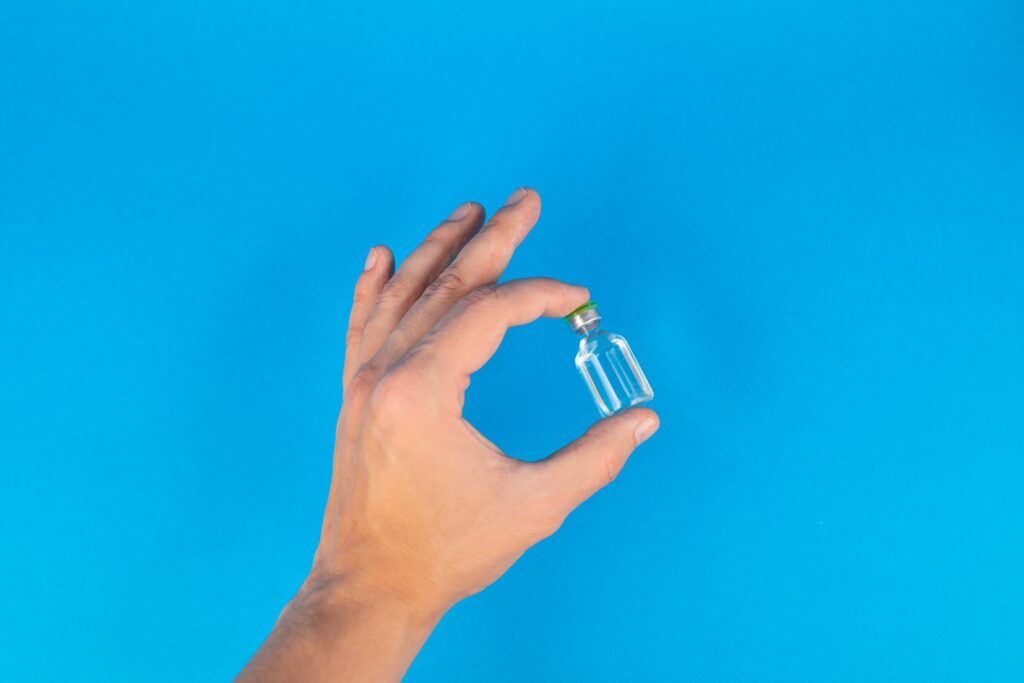
Bacteriostatic water is sterile water with one thing added: benzyl alcohol, at 0.9 percent. That single ingredient is the entire reason the product exists, and it is why a reconstituted vial can sit in a fridge for weeks instead of being discarded the same afternoon.
It is also the most commonly skipped decision in peptide handling. People research the compound extensively and then reach for whatever liquid is nearby, which is roughly like sourcing a rare ingredient and cooking it in tap water. Here is what bacteriostatic water actually is, how it differs from the alternatives, and how long anything mixed with it stays usable.
What bacteriostatic water is
Bacteriostatic water for injection is water that has been sterilized and then had a preservative added. The preservative is benzyl alcohol, present at 0.9 percent by volume in a multiple-dose container, most commonly 10mL or 30mL, though smaller formats exist.
The word to notice is bacteriostatic rather than bactericidal. Bactericidal agents kill bacteria. Bacteriostatic agents inhibit their ability to reproduce. Benzyl alcohol does the second thing, which is enough to prevent a contaminating organism from establishing a population inside the vial but is not the same as sterilizing whatever gets introduced.
That distinction has a practical consequence people get wrong constantly. Bacteriostatic water does not make a dirty needle safe. It suppresses growth of what enters, buying time and reducing risk; it does not undo a contamination event.
Bacteriostatic water vs sterile water and saline
Three liquids get used in this context and they are not interchangeable.
| Bacteriostatic water | Sterile water | Sodium chloride 0.9% | |
|---|---|---|---|
| Preservative | Benzyl alcohol 0.9% | None | None, unless bacteriostatic |
| Vial type | Multi-dose | Single use | Usually single use |
| Usable after first puncture | Weeks | Same session | Same session |
| Tonicity | Hypotonic | Hypotonic | Isotonic |
| Typical use | Repeated withdrawals | Single preparation | Where isotonicity matters |
Sterile water contains nothing living at the moment it was sealed and has no way to stay that way once a needle goes through the stopper. Treat it as single-session material.
Sodium chloride at 0.9 percent, ordinary saline, is isotonic, meaning its salt concentration matches physiological fluid. That matters in some applications and not for simply dissolving a lyophilized powder. Plain saline carries no preservative, so it has the same single-session limitation as sterile water unless you specifically have the bacteriostatic version.
Dilute acetic acid is the fourth option and shows up for peptides that resist dissolving in neutral water. It is a solubility tool rather than a general-purpose solvent, used where a supplier specifies it.
Where a supplier specifies a solvent, that specification overrides any general rule, including everything above.
Why benzyl alcohol is the active ingredient that matters
Benzyl alcohol is an aromatic alcohol used as a preservative across a wide range of injectable products. It disrupts bacterial cell membranes, which is why growth stalls.
Two things about it are worth knowing beyond the mechanism.
The first is a genuine safety matter with a documented history. Benzyl alcohol is contraindicated in neonates. In the early 1980s a cluster of deaths in premature infants was traced to benzyl alcohol toxicity, producing what became known as gasping syndrome, and preserved solutions have carried that contraindication ever since. It is one of the clearest examples in pharmacy of a preservative that is well tolerated in adults and dangerous in a specific population.
The second is that a small number of compounds are chemically sensitive to benzyl alcohol, and some proteins can be destabilized by it. This is uncommon among the short peptides in general research use, but it is the reason supplier specifications exist rather than a universal default.
Worth noting what benzyl alcohol does not do. It has no antifungal or antiviral action worth relying on, and it does nothing about endotoxin, the bacterial cell wall fragment that survives sterilization and is not removed by a preservative. Bacteriostatic water addresses one specific risk, which is bacterial proliferation inside an opened vial over time. It is not a general safeguard against contamination, and treating it as one is how people end up being casual about technique on the grounds that the water will handle it.
How long bacteriostatic water lasts once opened
Unopened, the manufacturer’s expiry date on the vial governs, and these products are stable for a long time at room temperature.
Once the stopper is punctured, the widely applied convention for multi-dose vials is a 28-day discard window, which derives from pharmacy compounding standards for preserved multi-dose containers. Some manufacturers specify their own interval, and where they do it takes precedence.
Twenty-eight days is a limit rather than a guarantee. It assumes the vial is entered with a fresh needle each time, stored properly between uses, and inspected before each use. A vial entered carelessly ten times is in worse shape than one entered twice, and the calendar does not know the difference.
Note also that this window is separate from the stability of whatever the water was used to reconstitute. A peptide in solution has its own shorter timeline, usually cited in the range of three to four weeks refrigerated and varying by compound. The reconstitution guide goes through that timeline and what shortens it.
How to store bacteriostatic water
Room temperature is correct, in the original vial, away from direct light. It does not require refrigeration and freezing it serves no purpose.
Wipe the stopper with alcohol before every entry and let it dry, because alcohol carried in on a wet stopper ends up in the solution. Use a fresh sterile needle each time. Inspect before use: the contents should be completely clear and colorless with no particulates, and anything cloudy, discolored or containing visible matter should be discarded rather than assessed optimistically.
Label the vial with the date of first puncture. Without that date the 28-day window is unenforceable, and a vial of unknown age is a vial you cannot reason about.
How much bacteriostatic water a vial of peptide needs
The arithmetic is straightforward and has exactly one equation.
Concentration equals total milligrams in the vial divided by milliliters of solvent added.
A 10mg vial with 2mL yields 5mg/mL. The same vial with 5mL yields 2mg/mL. Nothing about the compound changed, only the dilution.
Two constraints sit on top of the maths. The vial has to physically hold the volume, and a 2mL peptide vial will not accept 5mL regardless of the calculation. And more dilute solutions make small volumes easier to measure accurately, which is why researchers working with fine gradations often prefer them.
Vial sizes differ by compound, so check the product page before calculating. The strengths listed for BPC-157 and retatrutide are not the same, and neither is what a full vial of each will hold.
One further note on shelf life that trips people up: the printed expiry date applies to the sealed vial, not to an opened one. An in-date vial opened three months ago is governed by the discard window, not by the label, and the label is the number people tend to remember.
Mistakes that ruin a vial of bacteriostatic water
Almost all of them come from the same small list.
Coring the stopper. Pushing a needle straight through at a right angle can punch out a small disc of rubber that falls into the vial. Entering at a slight angle with the bevel facing up avoids it. A cored stopper also seals badly afterward, which shortens the vial’s usable life independently of the debris.
Not letting the alcohol dry. Wiping the stopper is correct and rushing the next step is not. Alcohol carried in on a wet stopper ends up in the solution, in an amount nobody measured.
Reusing needles. The single most common shortcut and the one bacteriostatic water is least able to compensate for. The preservative suppresses growth of what enters; it does not sterilize it.
Losing track of the open date. Without a date written on the vial the discard window is unenforceable, and an undated vial is one you cannot reason about at all.
Buying the large format by default. Covered below, and worth its own line because the unit price is genuinely misleading.
Assuming cloudiness will settle. It will not. A clear solution that has become cloudy has changed in a way that visual inspection cannot characterize, and the correct response is disposal rather than optimism.
Two vials of the same nominal volume from different manufacturers can also differ in stopper quality, which affects how well the seal holds across repeated entries. It is not something a product listing will tell you, and it is a reason to stay with a supplier once one works rather than optimising the price every order.
Where to buy bacteriostatic water for peptides
This is a pharmaceutical-grade product and the things worth checking are unglamorous: that it is manufactured to the relevant standard, that the vial is sealed and within date, that the label states the benzyl alcohol concentration, and that the volume suits how much you will actually use before the discard window closes.
That last point is the one people get wrong in the other direction, and it is worth working through properly because the arithmetic is counterintuitive.
A 30mL vial has a much better price per millilitre than a 3mL vial. It also has the same 28-day clock as every other multi-dose vial, running from first puncture rather than from when it empties. Someone using 2mL a month has bought 30mL and will use roughly 2mL of it, discarding the rest. The effective cost per millilitre used is then far worse than the small format, not better, and the apparent saving inverts entirely.
Smaller formats also mean fewer punctures per vial, and each entry is a contamination opportunity and a small insult to the stopper’s seal. A vial entered twice is in better condition than one entered fifteen times, regardless of what the calendar says.
The sensible rule is to buy the format matching consumption over four weeks, and to treat the unit price as the less relevant number of the two.
Healio stocks bacteriostatic water in a 3mL format alongside the compounds it goes with, and publishes third-party certificates for every peptide batch openly before purchase. The peptides for healing collection and the weight loss collection hold the lyophilized compounds that require it.
Bacteriostatic water for peptides: frequently asked questions
What is bacteriostatic water used for?
It is used to dissolve lyophilized powders where the resulting solution will be drawn from more than once. The benzyl alcohol preservative inhibits bacterial growth inside the vial, which allows repeated withdrawals over a period of weeks rather than requiring the solution be used in a single session.
What is the difference between bacteriostatic water and sterile water?
Sterile water contains no preservative, so once the stopper is punctured there is nothing preventing growth of anything introduced. Bacteriostatic water contains 0.9 percent benzyl alcohol, which inhibits bacterial reproduction and makes multi-dose use possible. Sterile water is single-session material.
How long is bacteriostatic water good for after opening?
The commonly applied convention is 28 days from first puncture, derived from pharmacy standards for preserved multi-dose containers, unless the manufacturer specifies otherwise. That assumes proper storage, a fresh needle at each entry, and visual inspection before each use.
Can you use tap water or distilled water for peptides?
No. Neither is sterile, and both may contain minerals and dissolved organic material that can interact with the compound or introduce contamination. The same applies to drinking water and to leftover solutions from other products.
Does bacteriostatic water need to be refrigerated?
No. Store it at room temperature in its original vial, away from direct light. Refrigeration is unnecessary and freezing serves no purpose. The peptide solution made with it is a different matter and is normally refrigerated, as the reconstitution guide covers.
Related reading
- How to Reconstitute Peptides: the bench procedure, the maths, and what ruins a vial
- Best Peptide Companies in 2026: the criteria to apply to any supplier
- Best Peptides for Women: the full picture, sorted by research goal
- How to Read a Certificate of Analysis: verifying what is actually in the vial
- Peptide reconstitution calculator, for the arithmetic behind any vial.