
Melanotan II and PT-141 get lumped together because they share a family tree, and most pages that compare them argue about which one is stronger. That’s the wrong axis. Both are synthetic relatives of alpha-melanocyte-stimulating hormone, a natural melanocortin, and both were built by modifying that same hormone. What separates them is the shape of the evidence. One has a small pilot study and a trail of case reports. The other has randomized phase 3 trials. This Melanotan vs PT-141 comparison covers what each compound is, what the published papers measured, why the pigmentation question keeps coming up, and what to ask of a lab report. Everything below describes laboratory research and published studies, nothing more.
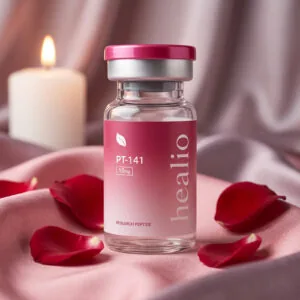 PT-141
Melanotan vs PT-141: what is the difference?
Melanotan II is a cyclic heptapeptide analog of alpha-MSH, described in the 1990s for its powerful pigmenting activity. PT-141, also called bremelanotide, is a synthetic melanocortin analog developed later for sexual function research, and a 2006 study identified it as an agonist at the MC3 and MC4 receptors. Both act on the melanocortin system. The practical difference is the record around them: PT-141 has randomized, placebo-controlled trials in premenopausal women, and Melanotan II has a pilot in three men plus published case reports of adverse events. That gap in evidence quality says more than any claim about potency.
Melanotan vs PT-141 side by side
The table holds the facts the literature supports. PT-141’s size, price and batch data are pulled live from the product and certificate pages, and the Melanotan cells say what to ask a seller. The same table answers searches phrased as PT-141 vs melanotan 2, melanotan 2 vs bremelanotide and PT-141 vs MT2.
| Melanotan II | PT-141 | |
|---|---|---|
| What it is | Cyclic heptapeptide analog of alpha-MSH | Synthetic melanocortin analog, also called bremelanotide |
| Receptors in the papers cited | Melanocortin system, with pigmenting activity | Agonist at MC3R and MC4R |
| Best-known human data | Pilot in 3 healthy men, plus case reports | Two randomized phase 3 trials and an open-label extension |
| Population studied | Healthy male volunteers in the pilot | Premenopausal women |
| Size and price | Varies by seller | 10mg vial, $34.99 |
| Latest batch purity (HPLC) | Ask the seller for the batch report | 99.5% |
| Certificate | Ask the seller for the certificate | PT-141 COA |
What Melanotan II is and what its research covers
The foundational paper is Dorr and colleagues’ 1996 pilot in Life Sciences. Three healthy men received injections over two weeks with the level stepped up in each, and the authors recorded mild nausea, somnolence and fatigue in one man at the highest level, a stretching and yawning complex, spontaneous erections, and increased pigmentation in two of the three. Hadley’s 2005 summary in Peptides describes how the sexual effects were noticed by accident while the group was studying tanning, and reports enhanced sexual function in men and increased desire and arousal in women. Both are short, small and hypothesis-generating. Neither is a trial with a control arm large enough to estimate anything.
What PT-141 is and what its research covers
PT-141’s literature starts in the same melanocortin territory and then moves into a clinical program. Diamond and colleagues in the Journal of Sexual Medicine randomized 18 premenopausal women with sexual arousal disorder to a single intranasal bremelanotide dose or placebo, and described the compound as an agonist at MC3R and MC4R. A short 2004 overview in Current Opinion in Investigational Drugs tracked its development as a nasal spray. The strongest material is Kingsberg and colleagues’ RECONNECT paper in Obstetrics and Gynecology: two identical phase 3, randomized, double-blind, placebo-controlled trials in premenopausal women with hypoactive sexual desire disorder, 24 weeks each. Simon and colleagues followed it with a 52-week open-label extension reporting long-term safety. The site’s PT-141 guide goes through the research in plain language.
Why the pigmentation question keeps coming up
Melanocortins act on melanocytes, which is why Melanotan II tans skin. Dorr’s pilot saw it in humans, and the pigmenting activity is the reason the compound was developed. The concern is what else it does to those cells. Two published case reports are worth reading before you decide how much weight a forum thread deserves. Reid and colleagues in the Irish Medical Journal describe a patient who developed multiple new atypical naevi within a week of two melanotan injections. Cardones and Grichnik in Archives of Dermatology described eruptive nevi after self-administered synthetic alpha-MSH in a man with a history of melanoma, and concluded that such peptides can drive proliferation of neoplastic melanocytic cells in predisposed patients. A toxicology case from Chicago, Nelson and colleagues in Clinical Toxicology, reported sympathomimetic toxicity and rhabdomyolysis after a product purchased online. Case reports can’t establish how common any of this is. They do show why a pilot study of three men shouldn’t be read as a safety record.
Melanotan and PT-141 evidence, laid out as a ledger
Put the two records next to each other and the contrast is plain.
- Melanotan II: a 1996 pilot in three men, a 2005 narrative summary, and several adverse event case reports, with no randomized trial in the sources cited here.
- PT-141: a 2006 randomized study in 18 women, plus two phase 3 trials of 24 weeks each and a 52-week extension.
Stronger evidence doesn’t make a compound better. It makes the claims about it checkable. A page that treats the two as interchangeable is treating a pilot and a phase 3 program as the same grade of knowledge.
How to read a Melanotan vs PT-141 comparison page
Comparison pages for this pair tend to fall into three types. Clinic pages describe PT-141 in the language of its trials and treat Melanotan as the cheaper cousin. Vendor pages lean on receptor details that rarely come with a citation. Forum threads rank them by anecdote. The filter is the same as for any compound: for each claim, find the paper, then check which compound it studied, in whom, and over what period. Where the answer is three men for two weeks, the claim is a pilot claim, and where the answer is two 24-week trials in premenopausal women, it is a claim about that population and nothing broader.
Melanotan vs PT-141 in women’s research
The two records point at different populations. Dorr’s pilot used men, and the RECONNECT trials and Diamond’s study used premenopausal women, so the PT-141 literature is one of the few melanocortin sets built around female participants. That makes it a natural reference for a woman framing her own research question. The limits are as important: the trials concern one defined condition in a defined population, and they don’t extend to post-menopausal women or to other outcomes. The PT-141 for women page covers the research in that setting, and kisspeptin is the other signaling peptide often searched next to it.
What the Melanotan and PT-141 studies can’t tell you
A trial in premenopausal women says nothing about men, and a pilot in men says nothing about women. Melanotan II’s case reports involve products bought online or self-administered, where the contents weren’t verified, and they can’t separate the compound from the product. The PT-141 trials measured questionnaire scores and safety events over months, not mechanisms. Neither literature tests the two compounds against each other, so a statement that one is stronger or safer is a statement about two separate sets of papers.
PT-141 COA: what a lab report shows, and what to ask for on Melanotan
Every Healio Peptides batch is tested by an independent US laboratory before release, and the report is published before you order. This is the current PT-141 batch.
| PT-141 | |
|---|---|
| Batch | HEALIO-PT141-2610 |
| Purity (HPLC) | 99.5% |
| Identity (ESI-MS) | Confirmed, conforms to the reference standard (1025.16) |
| Endotoxins (LAL) | Under 0.5 EU/mg (limit 5 EU/mg) |
The same four lines are what to ask for from any seller of Melanotan II. Given the case reports, identity and endotoxin results matter most: the first confirms the molecule on the label, and the second speaks to what else is in the vial. A lot number that matches the vial closes the loop. Reading a peptide certificate of analysis explains each row.
PT-141 price and format
Healio Peptides lists PT-141 as a 10mg vial, lyophilized powder, at $34.99, which is $3.50 per mg. Melanotan II strengths and prices vary by seller, so compare cost per milligram. The early PT-141 trials used an intranasal formulation, and that is a different product from a lyophilized vial, so a result in one form doesn’t carry to the other. Reconstitution uses bacteriostatic water for sale, and the PT-141 calculator turns vial strength and water volume into a concentration. How to reconstitute peptides covers the handling.
Where to buy PT-141 for research
Whichever compound you source, look for a published certificate before anything else. Every Healio Peptides batch ships with a third-party report, and orders go out from the United States. The PT-141 for sale page carries the certificate before you order, and the women’s wellness peptides category shows the neighboring compounds.
Melanotan vs PT-141: frequently asked questions
Is PT-141 the same as Melanotan 2?
No. Both are synthetic melanocortin analogs of alpha-MSH, but they are separate molecules with separate research records. Melanotan II appears in the 1990s pigmentation papers, and PT-141 was developed later and carried through phase 3 trials.
Which has more published human data, Melanotan or PT-141?
PT-141. The sources cited here include two randomized phase 3 trials and a 52-week extension, against a three-man pilot and case reports for Melanotan II.
What do the case reports on Melanotan say?
They describe new or changing naevi after injection, including in a patient with a history of melanoma, and one case of systemic toxicity after an online-purchased product. Case reports can’t give a rate, but they are the reason to ask for identity and endotoxin results.
What should a PT-141 or Melanotan certificate show?
Purity by HPLC, identity by mass spectrometry, an endotoxin result and a lot number that matches the vial. Match the batch number to the vial before anything else.
Are PT-141 and Melanotan FDA approved?
Nothing on this page is a statement about any product’s legal status or medical advice. Healio Peptides sells PT-141 strictly for laboratory research, and the studies described here are published research, not guidance.
Do PT-141 and Melanotan reviews tell me anything useful?
Reviews mix different products, forms and expectations, so they say little about any one vial. A batch certificate says more: it ties a purity and identity result to a lot number you can check.
More on melanocortin and signaling peptides
- Peptides for libido, what each compound was studied for.
- BPC-157 vs KPV, a short peptide with its own alpha-MSH link.
- KLOW vs KPV, where the alpha-MSH fragment sits inside a blend.
Healio Peptides supplies research compounds for laboratory use only. They are not for human or veterinary use, have not been evaluated by the FDA, and nothing on this page is medical advice.