
Most arguments about CJC-1295 and ipamorelin against tesamorelin start with mechanism, and mechanism is the least useful place to start. All three end at the same pituitary and the same hormone. What separates them is how much has been measured. Tesamorelin went through phase 3 trials with a CT scan as the endpoint. CJC-1295 has dose-ascending studies in healthy adults that measured hormone levels. Ipamorelin has a pharmacology paper, an animal model and one human trial in a different field entirely. This CJC-1295 and ipamorelin vs tesamorelin comparison covers what each compound is, what the published studies found, why the pairing exists, and what a lab report should show. Everything below describes laboratory research.
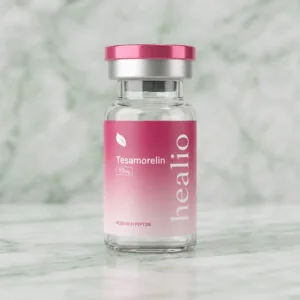 Tesamorelin
CJC-1295 and ipamorelin vs tesamorelin: what is the difference?
CJC-1295 and ipamorelin are two compounds that reach the pituitary by two receptors. CJC-1295 is a long-acting analog of growth hormone-releasing hormone, or GHRH, and ipamorelin is a ghrelin-receptor agonist. Tesamorelin is a single compound that acts only on the GHRH receptor, like CJC-1295. So the comparison is really two questions folded together: one GHRH analog against another, and one signal against two. The evidence for each question is uneven, and the sections below take them in turn.
CJC-1295, ipamorelin and tesamorelin side by side
The table holds what the literature supports. Tesamorelin’s size, price and batch data are pulled live from the product and certificate pages, and the other two columns say what to ask a seller. Searched as ipamorelin CJC-1295 vs tesamorelin or tesamorelin vs CJC-1295 ipamorelin, the table is the same.
| Tesamorelin | CJC-1295 | Ipamorelin | |
|---|---|---|---|
| What it is | A stabilized GHRH analog, GHRH(1-44) | A long-acting GHRH analog that binds albumin | A pentapeptide ghrelin-receptor agonist |
| Receptor | GHRH receptor | GHRH receptor | GHRP-like (ghrelin) receptor |
| Largest human record | Two pooled phase 3 trials, 806 patients | Dose-ascending trials in healthy adults | A phase 2 trial of 117 patients in postoperative ileus |
| Endpoint measured | Visceral fat by CT scan | Growth hormone and IGF-I levels | Time to a tolerated meal |
| Size and price | 10mg vial, $89.99 | Varies by seller | Varies by seller |
| Latest batch purity (HPLC) | 99.5% | Ask the seller for the batch report | Ask the seller for the batch report |
| Certificate | Tesamorelin COA | Ask the seller for the certificate | Ask the seller for the certificate |
Tesamorelin: the GHRH analog with the trial record
The key paper is Falutz and colleagues in the Journal of Clinical Endocrinology and Metabolism, a pooled analysis of two phase 3 studies in 806 HIV patients on antiretroviral therapy with excess abdominal fat. Visceral adipose tissue measured by CT fell significantly against placebo at 26 weeks, with a treatment effect of 15.4 percent, and subcutaneous fat didn’t change meaningfully. Dhillon’s review in Drugs describes the analog as indicated for reducing excess abdominal fat in HIV-associated lipodystrophy, and notes that visceral fat re-accumulated when treatment stopped. A later randomized trial, Stanley and colleagues in Lancet HIV, enrolled 61 people with HIV and fatty liver disease and reported a greater reduction in liver fat than placebo. All of it concerns one patient population. The tesamorelin peptide guide goes through the compound in more detail.
CJC-1295: GHRH, engineered to last
CJC-1295 starts from the same problem tesamorelin does, that GHRH is short-lived, and solves it differently. Teichman and colleagues ran two randomized, placebo-controlled trials in healthy adults and reported dose-dependent rises in mean growth hormone of 2- to 10-fold for six days or more and in IGF-I of 1.5- to 3-fold for nine to eleven days, with an estimated half-life of 5.8 to 8.1 days. Ionescu and Frohman showed that the pulses survived: in healthy men, pulse frequency and size were unchanged, and baseline levels rose. Both papers study the albumin-binding form, which is why it’s the form that matters when a seller lists CJC-1295 “with DAC” or without it. A result from one form can’t be borrowed for the other.
Ipamorelin: a selective second signal
Raun and colleagues in 1998 introduced ipamorelin as the first selective growth hormone secretagogue. In swine, the older compounds GHRP-6 and GHRP-2 raised ACTH and cortisol, while ipamorelin did not, even at doses over 200-fold above the level that released growth hormone. That selectivity is most of why it displaced its predecessors in discussion. Its human trial, Beck and colleagues’ phase 2 study in postoperative ileus, found it well tolerated and no significant difference from placebo on the key efficacy endpoint. So ipamorelin has a good selectivity paper and a human record in a different field.
Why the CJC-1295 and ipamorelin pairing exists
The argument for combining a GHRH analog with a ghrelin-type compound comes from an older result. In a 1995 study in the Journal of Clinical Endocrinology and Metabolism, healthy controls given GHRH plus GHRP-6 released more growth hormone than the sum of the two given separately, and Ghigo’s review of growth hormone-releasing peptides covers the mechanisms. Notice what that rests on: GHRP-6, ipamorelin’s relative, and native GHRH. The papers here don’t test CJC-1295 with ipamorelin directly, so the pairing is a rational inference and not a measured result. Compare that with the CJC-1295 and ipamorelin vs sermorelin page, which looks at the same pair against a shorter-acting GHRH analog.
Tesamorelin vs CJC-1295 alone
Strip ipamorelin away and the comparison is two GHRH analogs engineered in different ways: tesamorelin stabilized as GHRH(1-44), CJC-1295 extended by albumin binding. Same receptor, different design, different measured outcomes. The tesamorelin record is a body-composition endpoint in a clinical population, and the CJC-1295 record is hormone kinetics in healthy volunteers. Neither tests the other. The sermorelin vs tesamorelin post covers the third GHRH analog in the family.
Three questions that filter most CJC-1295 and ipamorelin claims
First, which CJC-1295? With and without the albumin-binding feature are different molecules with different durations, and a page that doesn’t say which it means is either careless or repackaging someone else’s page. Second, is the claim about the pair or about one component? Much of what’s written attributes ipamorelin findings to the combination or the reverse, and the combination hasn’t been studied to the standard either compound has alone. Third, what was the endpoint? Growth hormone release is a measurable thing, but it isn’t a body-composition outcome or anything a person would notice. A compound can raise a hormone reliably and still show nothing on the outcome a page is selling. That third question is what separates tesamorelin’s CT-scan record from the rest.
What the CJC-1295, ipamorelin and tesamorelin studies can’t tell you
The tesamorelin trials enrolled people with HIV, so they say nothing about other populations or about a research-grade vial in a laboratory model. The CJC-1295 trials measured hormone levels in healthy volunteers over weeks and say nothing about longer-term outcomes. Ipamorelin’s human trial didn’t ask a growth hormone question at all. Nobody has published a head-to-head of the three, and nobody has tested the CJC-1295 and ipamorelin pair against tesamorelin. Every sentence that ranks them is stitching together separate papers.
Growth hormone peptide research in women
Ionescu’s pulsatility work enrolled healthy men aged 20 to 40, and the abstracts cited for the other compounds don’t report results by sex. Growth hormone secretion differs by sex and across the menstrual cycle, so a result in men can’t be assumed for women. A woman framing her own research question will want sex-stratified data, which is thin for all three. The tesamorelin for women page covers the compound with the deepest record, and the growth hormone peptides guide covers the family.
Tesamorelin COA: what a lab report shows, and what to ask for on CJC-1295 and ipamorelin
Every Healio Peptides batch is tested by an independent US laboratory before release, and the report is published before you order. This is the current tesamorelin batch.
| Tesamorelin | |
|---|---|
| Batch | HEALIO-TESA-2616 |
| Purity (HPLC) | 99.5% |
| Identity (ESI-MS) | Confirmed, conforms to the reference standard (5135.86) |
| Endotoxins (LAL) | Under 0.5 EU/mg (limit 5 EU/mg) |
Ask for the same four lines from any seller of CJC-1295 or ipamorelin: purity by HPLC, identity by mass spectrometry, an endotoxin result, and a lot number that matches the vial. For CJC-1295, also ask whether the certificate describes the albumin-binding form. A blended vial of two compounds is harder to verify than two separate ones, so ask how each component was confirmed. Reading a peptide certificate of analysis walks through each row.
Tesamorelin price and format
Healio Peptides lists tesamorelin as a 10mg vial, lyophilized powder, at $89.99, which is $9.00 per mg. CJC-1295 and ipamorelin strengths and prices vary by seller, so compare cost per milligram. Reconstitution uses bacteriostatic water for sale, and the tesamorelin calculator turns vial strength and water volume into a concentration. How to reconstitute peptides covers the handling.
Where to buy tesamorelin for research
Whatever you source, look for a published certificate before anything else, and match the lot number to the vial. Every Healio Peptides batch ships with a third-party report, and orders go out from the United States. The tesamorelin for sale page carries the certificate before you order, and the peptides for weight loss category shows the neighboring compounds.
CJC-1295 and ipamorelin vs tesamorelin: frequently asked questions
Is CJC-1295 with ipamorelin better than tesamorelin?
The research doesn’t establish that. Tesamorelin has pooled phase 3 trials with a CT-scan endpoint in one population, and the pairing has a mechanistic rationale and hormone-level studies. They answer different questions.
What is the difference between tesamorelin and CJC-1295?
Both are GHRH analogs acting on the same receptor. Tesamorelin is a stabilized GHRH(1-44), and the long-acting form of CJC-1295 binds albumin and showed an estimated half-life of 5.8 to 8.1 days in one trial.
What is the difference between CJC-1295 with and without DAC?
The DAC form is the albumin-binding, long-acting one studied in the Teichman and Ionescu papers. The other form is a different molecule, and results from one can’t be borrowed for the other, so check which form a certificate describes.
Why are CJC-1295 and ipamorelin combined?
They act on two different receptors. The rationale comes from older work showing GHRH plus GHRP-6 released more growth hormone than the sum of each alone, though the pair itself hasn’t been tested head to head in the papers cited here.
Are tesamorelin, CJC-1295 and ipamorelin FDA approved?
Nothing on this page is a statement about any product’s legal status or medical advice. A 2011 review describes a pharmaceutical tesamorelin as indicated for abdominal fat in HIV-associated lipodystrophy, which says nothing about research-grade vials. Healio Peptides sells tesamorelin strictly for laboratory research.
Do tesamorelin and CJC-1295 reviews tell me anything useful?
Reviews mix different products, forms and expectations, so they say little about any one vial. A batch certificate says more: it ties a purity and identity result to a lot number you can check.
More on growth hormone peptides
- Tesamorelin vs ipamorelin, two different receptors and two different records.
- CJC-1295 and ipamorelin vs sermorelin, one signal against two.
- Tesamorelin and ipamorelin blend, the limits of the combination.
Healio Peptides supplies research compounds for laboratory use only. They are not for human or veterinary use, have not been evaluated by the FDA, and nothing on this page is medical advice.