
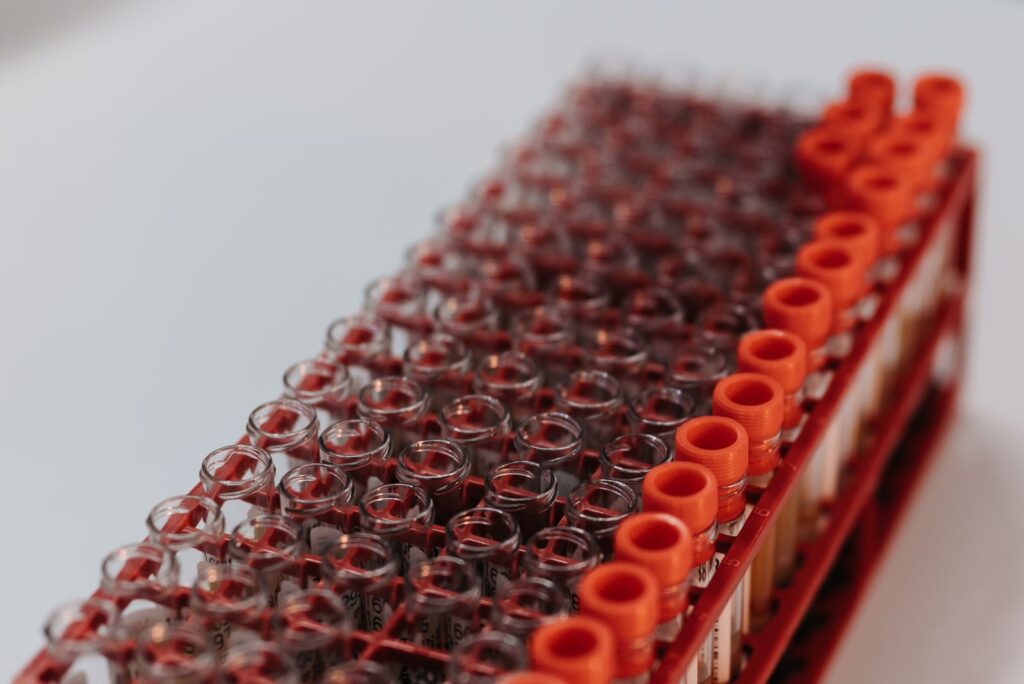
Every research peptide arrives as a powder, and that is not a shipping convenience or a cost decision. It is the single most important stability strategy in the entire category, and understanding why explains most of the handling rules that follow from it.
This guide covers what lyophilization is, why water is the enemy of a peptide, what the cake in the vial actually is, why it sometimes looks like almost nothing, how the dry form behaves in storage and transit, and what changes the moment solvent is added. Everything here describes laboratory handling of research materials, not personal use.
What are lyophilized peptides?
Lyophilization is freeze-drying: the material is frozen, then placed under vacuum so the frozen water passes directly from solid to vapour without becoming liquid. What remains is a dry cake containing the peptide and any excipients, with water removed. Storage conditions are one of the recognised sources of structural modification in synthetic peptides, alongside the starting materials and the manufacturing process.
A lyophilized peptide is therefore a peptide with the water taken out of it, sealed in a vial, waiting to be dissolved again.
The process matters as much as the outcome. Removing water by evaporation would require heat, and heat degrades peptides. Sublimation under vacuum removes water without the thermal stress, which is why this specific method became standard rather than simple drying.
Why water is the problem
The whole strategy makes sense once you know what water enables.
Hydrolysis is the reaction that breaks peptide bonds, and it requires water by definition. A peptide chain in solution is continuously exposed to the molecule needed to take it apart.
Water also enables other degradation routes. Molecular mobility increases in solution, which allows reactions that a rigid dry matrix physically prevents. Oxidation and aggregation both proceed more readily when molecules can move and encounter each other.
Removing water shuts down the primary route and slows the others substantially. This is why the same compound can be stable for a year or more as a dry cake and measured in days or weeks once dissolved. Peptide bond chemistry explains why, and peptide storage conditions follow from it.
What the cake in the vial actually is
A common source of confusion, particularly for people opening their first vial.
The visible material is not pure peptide. It is the peptide plus whatever excipients were present, formed into a porous structure by the freezing and drying process.
That porosity is functional rather than incidental. A well-formed cake has a large surface area, which is what allows it to dissolve quickly and completely when solvent is introduced. A collapsed or glassy cake dissolves more slowly and less predictably.
Appearance varies legitimately. Cakes can be white, off-white, fluffy, dense, or in some cases barely visible as a thin film on the vial base. That variation reflects the specific compound, the fill quantity and the lyophilization cycle used.
Why the vial can look empty
This causes genuine alarm and is usually nothing.
A 10mg peptide fill is a small mass. Spread across the base of a vial as a porous cake, it can present as a barely perceptible film, and people reasonably wonder whether they received an empty vial.
Cakes also dislodge in transit. Rough handling can shake the cake loose so that it sits as loose material or adheres to the stopper rather than forming a visible layer on the base.
Neither indicates a problem with the compound. What does indicate a problem is a cake that has visibly melted and reformed, which suggests temperature excursion, or one that has become discoloured.
The practical handling response is to let the vial settle before opening and to direct solvent down the vial wall rather than straight onto the cake, both part of the peptide reconstitution procedure.
How lyophilized peptides behave in transit
The dry form’s stability is what makes the entire supply chain workable.
Lyophilized peptides tolerate ambient temperatures for the duration of normal shipping, which is why they ship without cold chain. That tolerance is genuine and it is also finite.
Tolerating transit is not the same as being suitable for storage at those conditions. A vial that spent three days in transit has had a very different experience from one left on a bench for a fortnight, even though both were at room temperature.
On arrival, four checks take under a minute: seal and crimp intact, cake present and not visibly melted, label legible with lot number, and expiration date leaving a sensible margin. Sourcing bacteriostatic water has its own arrival checks.
None of these confirm integrity, since degradation is invisible. They catch gross failures and nothing subtler.
Storing lyophilized peptides
Dry, cold and dark, with one habit that matters more than the rest.
Frozen storage suits long-term holding, refrigeration suits shorter periods, and controlled room temperature is appropriate for transit rather than storage. The original carton provides light protection and usually carries the lot number.
The habit that prevents most avoidable loss is letting a cold vial reach room temperature fully before opening. Opening a cold vial draws warm air in, and condensation forms on the cold interior surfaces, reintroducing exactly the water lyophilization removed.
Freeze-thaw cycles compound that. Each transition is another condensation opportunity, and minimising the number of cycles matters more than optimising the temperature. The full set of storage conditions matters less here than the number of cycles.
What changes when solvent is added
Reconstitution is the moment the protection ends, and the shift is abrupt.
The compound moves from a state where its primary degradation route is largely disabled to one where it is fully available. Stability drops from months or years to days or weeks depending on the sequence.
Two clocks then start. The solvent has its own in-use window, conventionally 28 days for bacteriostatic water. The compound has its own stability profile, frequently shorter. The more restrictive governs.
This is why reconstitution is done immediately before the material is needed rather than on arrival. A vial reconstituted early is a vial spending its usable window sitting in a refrigerator. A peptide reconstitution calculator handles the concentration arithmetic that has to be recorded at that moment.
Excipients and why some cakes look different from others
Not every lyophilized vial contains only the peptide, and knowing why explains a lot of the appearance variation people notice.
Excipients are additional substances included in the formulation before freezing to improve the lyophilization process itself. Bulking agents give a fragile, low-mass fill enough structure to form a stable cake rather than collapsing into an unusable film. Buffering agents can be included to stabilise pH once the material is reconstituted.
A peptide present at a small fill weight, on its own, can produce a cake so minimal it is difficult to see at all. The same peptide formulated with a bulking agent produces a more substantial, more visibly structured cake, without the peptide content having changed at all.
This is why comparing the visual appearance of vials from different sources tells you very little. A fluffier cake is not necessarily a better one, and a minimal one is not necessarily a warning sign. What matters is documented on the certificate of analysis, not visible in the vial. A third-party certificate of analysis explains what should be stated instead.
Why reconstitution technique matters more for lyophilized material
The dry, porous structure that makes storage stability possible also makes the reconstitution step more delicate than it looks.
Directing solvent forcefully straight onto the cake can disturb it violently, sending material up the vial walls or creating foam. Foaming is a particular problem for peptides, since the process of forming a foam can denature protein structure at the air-liquid interface, degrading the very material being dissolved.
The standard technique is to direct the solvent stream down the interior vial wall rather than onto the cake, allowing it to run down and contact the material gently, then to let the vial stand or gently swirl rather than shake.
Shaking a peptide solution to speed dissolution is close to the least effective way to achieve full dissolution and the most effective way to damage the compound in the process. Patience during this single step protects everything the lyophilization process was designed to preserve.
Why lyophilization affects what a purity figure means
A subtler point worth knowing for reading documentation.
The mass stated on a vial is a nominal fill quantity. Overfill is normal in lyophilized manufacturing, and residual moisture content after drying affects the actual figure too.
That is not a criticism of the process, it is a property of it, and it is one reason batch documentation matters rather than trusting the label alone. What a certificate of analysis should state is specific, and peptide purity testing is how those numbers are produced.
For concentration arithmetic the practical approach is to work from the stated mass while understanding it is nominal, which is what every research protocol does. Precision beyond that requires assay data rather than a label.
Lyophilized peptides: frequently asked questions
What are lyophilized peptides?
Peptides that have been freeze-dried, meaning frozen and then placed under vacuum so water sublimes directly from solid to vapour. What remains is a dry cake, sealed in a vial, awaiting reconstitution.
Why are peptides supplied as powder?
Because water enables hydrolysis, the reaction that breaks peptide bonds, along with other degradation routes. Removing water shuts down the primary route, which is why the dry form is stable for months or years while solutions last days or weeks.
Why does my vial look empty?
A 10mg fill is a small mass and can present as a barely visible film across the vial base. Cakes also dislodge in transit and may sit as loose material or adhere to the stopper. Neither indicates a problem.
What does a good lyophilized cake look like?
Appearance varies legitimately by compound, fill quantity and drying cycle, from fluffy and white to dense or nearly invisible. What does indicate a problem is a cake that has visibly melted and reformed, or become discoloured.
Do lyophilized peptides need cold shipping?
The dry form tolerates ambient temperatures for normal transit durations, which is why cold chain is not used. That tolerance is finite and is not the same as being suitable for storage at those conditions.
How long do lyophilized peptides last?
Frozen and dry, many remain stable for a year or more. Refrigerated in dry form the window is shorter but still measured in months. Once reconstituted the range drops to days or weeks depending on sequence.
Why let a cold vial warm before opening?
Opening a cold vial draws warm air in and condensation forms on the cold interior surfaces, reintroducing the water lyophilization removed. Warming first puts the condensation on the outside instead.
Is the stated vial mass exact?
It is a nominal fill quantity. Overfill is normal in lyophilized manufacturing and residual moisture affects the figure. Research protocols work from the stated mass while understanding it is nominal.
Referenced in this area, each with its batch certificate published before purchase: BPC-157, GHK-Cu. Everything else in this area sits in the full catalogue.
Dry is the whole strategy
Nearly every handling rule in this category traces back to one fact: peptides degrade in water, so the supply chain keeps them out of it until the last possible moment. Understanding that makes the storage guidance, the transit tolerance and the sudden shortening of the clock at reconstitution all follow from a single principle rather than being a list to memorise. Healio supplies every compound in the healing collection and anti-aging collection in lyophilized form, with batch documentation published before purchase.
Related reading
- How to Reconstitute Peptides, the moment the dry protection ends.
- How to Store Peptides, keeping the dry form dry.
- Bacteriostatic Water, the solvent that goes in.