
GHK-Cu has a strange profile for a research compound. It was identified in human plasma in 1973, has accumulated fifty years of published literature across wound healing, skin biology, hair follicles, and gene expression, and yet most people first encounter it on the back of a serum bottle where the actual research is nowhere in sight.
This is the compound monograph rather than a category guide. What GHK-Cu is, where it came from, what the research across several fields actually reports, and how to source it without paying a premium for marketing. For the skin application specifically, copper peptides for skin goes deeper on concentration; for how it compares against other compounds, the best peptides for skin pillar covers the field. This page is about the molecule itself, available in the skin and beauty collection.
What GHK-Cu is
GHK-Cu is a tripeptide, meaning three amino acids: glycine, histidine, and lysine. That is what GHK stands for. The Cu is copper, which the peptide binds with unusually high affinity, forming a copper complex that is the actual studied molecule rather than the bare peptide.
It occurs naturally in human plasma, and this is where the most-cited fact about it comes from: plasma levels decline substantially with age, from roughly 200 nanograms per milliliter around age 20 to about 80 by age 60. That observation is what launched most of the research interest, and it is also the single most over-interpreted data point in the entire copper peptide market.
A decline with age establishes a correlation. It does not establish that restoring levels reverses anything, and no research has demonstrated that it does. The compound is interesting because of what it appears to do mechanistically, not because of an arithmetic argument about topping up a number.
GHK-Cu peptide benefits reported across the research
The literature spans several fields, which is unusual for a compound this small, and the breadth is genuinely the most notable thing about it.
Wound healing is the oldest and deepest line. GHK-Cu was studied in tissue repair contexts long before it became a cosmetic ingredient, with research examining its role in the repair cascade: repair cells are drawn to the site first, then collagen and elastin synthesis increases.
Collagen and extracellular matrix research examines its relationship to fibroblast activity and matrix protein production, which is the mechanism behind essentially every skin claim attached to it.
Antioxidant and anti-inflammatory signaling appears throughout, and connects it to peptide inflammation research.
Gene expression is the most striking and most frequently exaggerated. Published work has examined GHK’s effect on the expression of a large number of human genes in cell culture. That is a real finding and it is a cell culture finding, which is a very different thing from a demonstrated outcome in a person.
Where GHK-Cu came from
The discovery story is worth knowing because it explains why the research looks the way it does. In the early 1970s, researchers studying why liver tissue from younger donors behaved differently from older tissue in culture isolated a small factor from human plasma that appeared to account for part of the difference. That factor was GHK.
The compound therefore entered the literature through aging and tissue-repair biology rather than through cosmetics, which is why the earliest and strongest work concerns wound healing rather than wrinkles. The skin care application arrived decades later, borrowing credibility from research that had been conducted for entirely different reasons.
This also explains the compound’s unusual breadth. Nobody set out to make a skin ingredient. They found a plasma factor, then followed it into whichever field its mechanisms pointed toward, which turned out to be several.
Why copper is the active part
The copper is not incidental packaging. Copper is a required cofactor for lysyl oxidase, the enzyme that cross-links collagen and elastin fibres, and for superoxide dismutase, one of the body’s antioxidant enzymes.
So the peptide portion appears to function partly as a delivery and regulation mechanism for copper, binding it in a form that is biologically usable and comparatively well tolerated. That framing explains a lot about the compound, including why the peptide alone and copper alone are not substitutes for the complex, and why formulation quality matters more here than for a simpler molecule.
GHK-Cu for hair research
The same signaling mechanisms studied in skin appear in follicle research, since follicles are surrounded by the connective tissue and vasculature GHK-Cu research concerns. That is the entire basis of the association, and it is an indirect one.
Peptides for hair loss explains what that research does and does not establish, including the limitation that the follicle-specific work is considerably thinner than the skin research on the same compound.
Blue powder, dosing forms, and what you receive
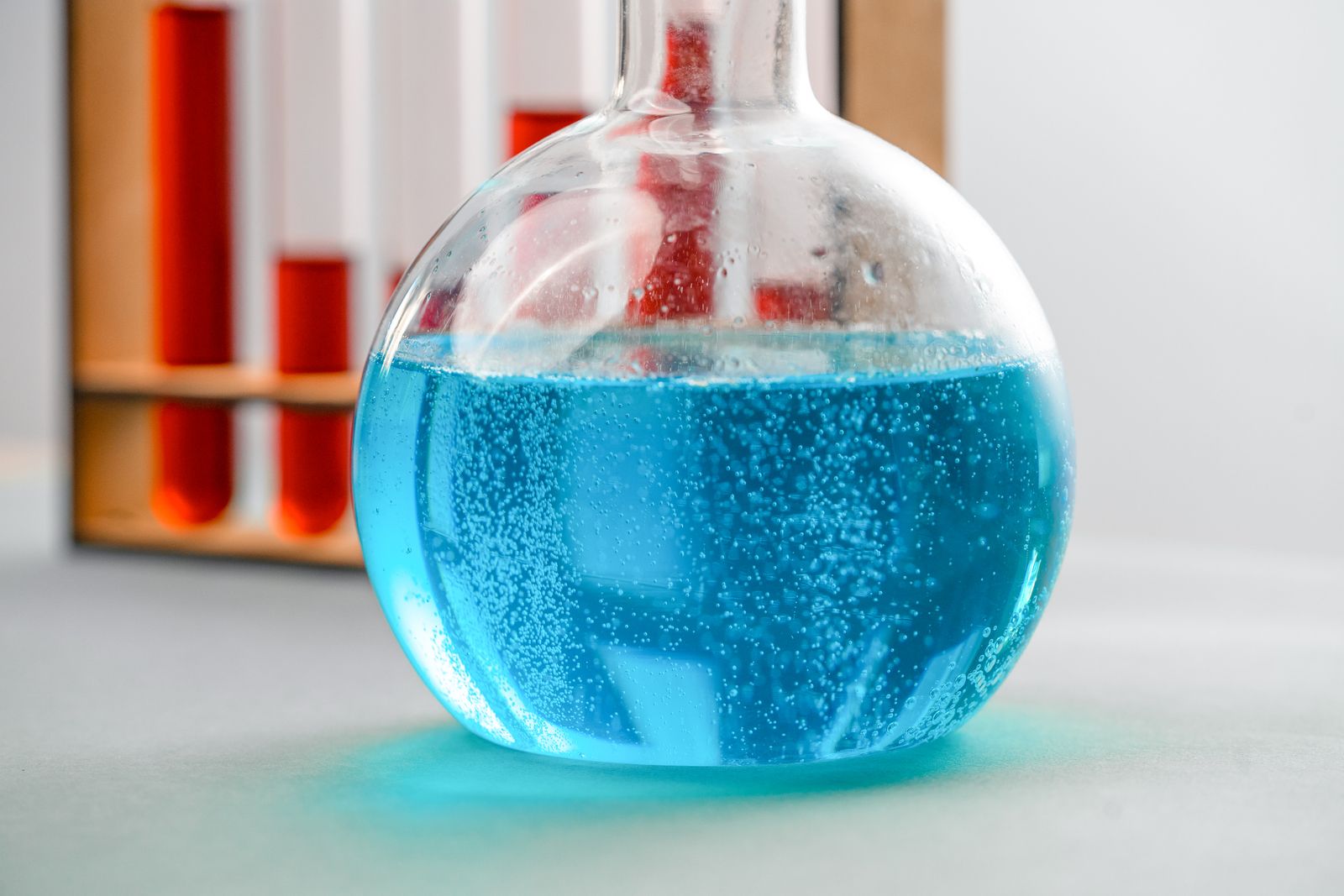
A practical note that surprises first-time buyers: GHK-Cu is blue. The copper complex gives it a distinctive deep blue colour in both lyophilized powder and solution, which is normal and expected rather than a sign of contamination.
What you should verify is that the blue is accompanied by documentation. Colour is not a purity indicator, and a vial being the right colour tells you only that copper is present in some form. A certificate of analysis lays out the checks that actually matter, including identity confirmation by mass spectrometry, which is the test that distinguishes GHK-Cu from something merely blue.
Why GHK-Cu appears in so many categories at once
Readers notice that this compound turns up under skin, hair, anti-aging, wound repair, and inflammation, and reasonably wonder whether anything can genuinely do all of that. The answer is that it is not doing five things. It is doing one thing that touches five fields.
Extracellular matrix remodeling, the process of breaking down and rebuilding the structural material between cells, is common to skin repair, follicle cycling, wound closure, and tissue maintenance generally. A compound studied for its role in that process will show up wherever that process matters.
The useful consequence for a reader: a claim in one category does not inherit evidence from another. Wound healing research is the deepest body of work on this compound, and the depth of that studies says nothing about how well it performs in a cosmetic formulation aimed at fine lines. Same molecule, different question, different evidence.
Research grade versus cosmetic grade
| Cosmetic copper peptide products | Research grade GHK-Cu | |
|---|---|---|
| Concentration | Typically low, often undisclosed | Stated, with purity percentage |
| Documentation | Rarely batch specific | Batch COA with lot number |
| Regulation | Cosmetic | Research compound, not for consumption |
| Identity testing | Not typically published | Mass spectrometry confirmation |
The distinction matters because studies people cite when buying a serum were generally not conducted on that serum. They were conducted on the compound, at concentrations the product may not disclose or approach.
What the GHK-Cu research does not establish
- No research supports GHK-Cu as a treatment for any medical condition.
- Gene expression findings in cell culture do not translate into demonstrated outcomes in people.
- The age-related plasma decline does not establish that supplementation reverses age-related change.
- Nothing sold here is intended for human application, and this is not guidance for personal use.
The compound’s real strength is the breadth and age of its mechanistic evidence base. That is a genuine advantage over compounds with three papers and a marketing budget, and it is still mechanistic evidence rather than clinical proof.
What buyers ask before sourcing GHK-Cu
A few practical questions recur. Does GHK-Cu need different handling than other peptides? Copper complexes are generally treated as light sensitive and are typically stored accordingly, but the broad storage principles are the same ones applying across lyophilized peptides rather than anything exotic.
Is a higher purity figure always better? For research consistency, yes, though identity confirmation matters more than the last decimal place of a purity number. A 99 percent pure sample of the wrong molecule is worse than a 98 percent sample of the right one.
Is it worth researching alongside other compounds? Combination approaches appear in the work, particularly where repair signaling is the shared mechanism, though combining anything makes attributing an observation harder. Peptide stacking carries that trade-off, and Healio’s GLOW 70 is the pre-built option for researchers working across more than one skin-relevant compound.
How to source GHK-Cu
GHK-Cu is widely sold and inconsistently documented, which is the predictable outcome of high demand meeting a compound most buyers cannot verify by eye.
Require a batch-specific certificate of analysis naming an independent laboratory, a stated purity figure, identity confirmation, and a lot number matching your vial. Healio publishes those documents openly for every batch rather than supplying them on request.
Handling follows general lyophilized peptide principles, so the standard reconstitution procedure applies, with bacteriostatic water as the diluent.
Frequently asked questions
What are GHK-Cu peptide benefits?
Published research examines GHK-Cu in wound healing, collagen and extracellular matrix production, antioxidant and anti-inflammatory signaling, and gene expression. These are mechanistic research findings rather than demonstrated clinical outcomes.
What does GHK-Cu stand for?
Glycine, histidine, and lysine, the three amino acids forming the tripeptide, plus Cu for the copper it binds. The copper complex is the studied molecule rather than the peptide alone.
Why is GHK-Cu blue?
The copper complex gives it a deep blue colour in powder and solution. This is expected rather than a defect, though colour confirms only that copper is present, not identity or purity.
Is GHK-Cu the same as copper peptides?
GHK-Cu is one specific copper peptide. “Copper peptides” is a broader marketing term sometimes applied loosely.
Does GHK-Cu decline with age?
Plasma levels have been reported to decline substantially between early adulthood and later life. That is a correlation with age and does not establish that restoring levels reverses age-related change.
Is GHK-Cu in skin care the same as research grade GHK-Cu?
The molecule is the same, the products are not. Cosmetic formulations are regulated as cosmetics, typically at undisclosed low concentrations, while research grade material is supplied at stated purity with batch documentation for laboratory use.
How do I verify GHK-Cu before buying?
A batch COA from a named independent lab with stated purity, identity confirmation, and a matching lot number. A certificate of analysis goes through the seven checks worth running.
Fifty years of published research, read accurately
GHK-Cu earns its reputation on research depth and loses it whenever that research gets described as more conclusive than it is. Both things are true at once. Every batch in the skin and beauty collection ships with independent testing published before purchase.
Related reading
- Copper Peptides for Skin, the skin application and the concentration problem.
- Best Peptides for Skin, how GHK-Cu compares across the category.
- Peptides for Hair Loss, the follicle research and its limits.
- How to Read a Certificate of Analysis, verifying any compound yourself.
- The peptide dosage calculator, which converts vial strength and water volume into a syringe reading.