
The first thing to know about GHK-Cu vs KLOW is how much of KLOW is GHK-Cu. An 80mg KLOW vial holds 50mg of it, which is more than five eighths of the contents, alongside 10mg each of BPC-157, TB-500 and KPV. The comparison is between the compound that dominates the vial by weight and the whole four-compound vial it sits in. This GHK-Cu vs KLOW comparison covers what each one is, what the published research covers, what the extra three compounds change, and what the batch lab reports show. Everything below describes laboratory research.
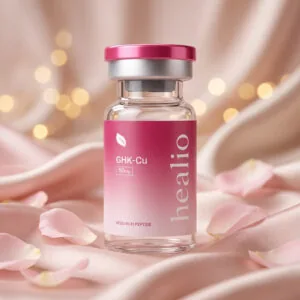 GHK-Cu
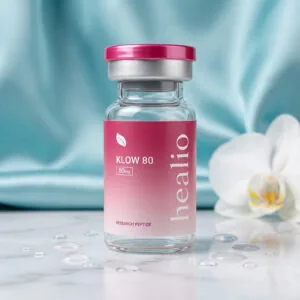 KLOW Peptide Blend
GHK-Cu vs KLOW peptide: what is the difference?
GHK-Cu is a copper tripeptide studied for tissue remodeling, skin biology and gene expression. KLOW is a blend that adds three more compounds to that same GHK-Cu: BPC-157 and TB-500, studied for repair and cell migration, and KPV, studied for inflammatory signaling. The difference is scope. A GHK-Cu vial lets a study isolate the copper peptide. A KLOW vial runs four compounds at a fixed ratio, so a result can’t be pinned on one ingredient. It’s the same question as GHK-Cu vs GLOW, with one more compound in the blend.
GHK-Cu vs KLOW side by side
The table holds the contents and the facts that rarely change, plus size, price and batch data pulled live from the product and certificate pages. Searched as KLOW vs GHK-Cu or GHK-Cu vs KLOW blend, the table is the same.
| GHK-Cu | KLOW 80 | |
|---|---|---|
| Contents | GHK-Cu only | 50mg GHK-Cu, 10mg BPC-157, 10mg TB-500, 10mg KPV |
| GHK-Cu share of the vial | All of it | Five eighths by weight |
| Main areas studied | Tissue remodeling, skin biology, gene expression | Remodeling, repair, cell migration, inflammatory signaling |
| Evidence type | Reviews, cell work and animal models | Each component has its own record, none for the blend |
| Size at Healio Peptides | 50mg and 100mg | 80mg |
| Price | from $34.99 | $119.99 |
| Latest batch purity (HPLC) | 99.4% | 99.2% |
| Certificate | GHK-Cu COA | KLOW COA |
What GHK-Cu is and what its research covers
GHK is a three amino acid peptide, glycyl-histidyl-lysine, that binds copper. Pickart’s paper in the Journal of Biomaterials Science reviews the tripeptide and tissue remodeling, and a later review of its regenerative and protective actions looks at the compound in the light of newer gene data. A third paper, Pickart’s “GHK and DNA: resetting the human genome to health”, takes up the gene expression angle. These are largely review and cell work from the same research tradition, so independent replication matters. The GHK-Cu peptide benefits page goes through the research in plain language.
What the other three compounds in KLOW add
BPC-157 is covered by the 2025 systematic review in HSS Journal, which kept 36 studies from 544 articles, 35 of them preclinical. TB-500 is sold as a fragment of thymosin beta-4, and Sosne’s FASEB Journal review describes short sequences within thymosin beta-4 that carry cell migration and wound-healing activity. KPV is studied in Dalmasso and colleagues’ Gastroenterology paper, where it entered intestinal cells through the PepT1 transporter and reduced inflammation in mouse colitis. Each of those literatures was built with its compound alone. The KLOW vs KPV page goes through that third component in more depth.
Why a KLOW result can’t be pinned on GHK-Cu
Suppose a study applies KLOW to a skin or wound model and sees a change. GHK-Cu is a candidate, since remodeling is its territory. So is BPC-157 for repair, TB-500 for migration and KPV for the inflammatory signal. Without a GHK-Cu-alone arm, the blend can’t tell you which compound did it, or whether it took more than one. That is the case for the GHK-Cu for sale listing next to the blend: a design can run the blend, GHK-Cu alone, and a control, and read the difference. A pre-mixed vial can’t be unmixed afterward.
Which research question fits GHK-Cu and which fits KLOW
A question about copper peptide biology, such as gene expression in a skin cell model, maps onto GHK-Cu alone. A question about a broader tissue model, where remodeling, repair, migration and inflammation all matter, is what the blend is for. Nobody has published a head-to-head of KLOW against GHK-Cu, so there is no result to say one is stronger. The choice is about design: isolate one variable, or accept four at a fixed ratio.
What the three extra compounds cost on their own
A practical way to see what KLOW adds is to price the rest of the vial. The three non-copper compounds, BPC-157, TB-500 and KPV, come to $179.97 as separate vials at their lowest listed sizes. KLOW 80 is $119.99 and a GHK-Cu vial is from $34.99. So the step from GHK-Cu alone to the full blend is a step to four compounds in one vial, and the live figures show what that step costs in each route. The numbers are calculated from the listed prices, so they move when the prices do.
GHK-Cu 50mg, 100mg and the 50mg inside KLOW
GHK-Cu is listed in 50mg and 100mg vials, and KLOW carries 50mg of it. That makes the 50mg GHK-Cu vial the direct reference for the copper peptide content of KLOW: the same amount of GHK-Cu, without the other three compounds. A study that wants the blend’s copper peptide share on its own can use that vial as its single-compound arm, and the GHK-Cu calculator shows the concentration arithmetic for each size. The larger vial suits a design that needs more of the copper peptide than the blend contains.
Reading threads that compare KLOW with separate GHK-Cu
Online discussions of KLOW against separate compounds mostly turn on how much of each ingredient a vial delivers, which is arithmetic, not evidence. The anecdotes that follow can’t separate the compound from expectation or the rest of a routine. The useful parts of those threads are the questions: what is the ratio, what does the certificate say, and which ingredient is under test. The ratio is on this page, the certificates are linked, and the biology is in the papers above.
GHK-Cu vs KLOW in women’s research
Skin and wound models are where women researchers often start, and the GHK-Cu literature is mostly review and cell work, with the abstracts not reporting results by sex. The BPC-157 repair work leaned on male animals, and the KPV papers are rodent studies. A woman reading across to her own question will want sex-stratified results, and for this set they are scarce. The BPC-157 research gap in women covers the repair side in detail.
What the GHK-Cu and KLOW studies can’t tell you
Much of the GHK-Cu record is review and cell culture work, and a result in cultured cells doesn’t predict a result in tissue. The KPV and BPC-157 papers use different models, routes and schedules, so their results can’t be laid side by side. For the blend itself, there is no published paper testing the four compounds together at these ratios. Everything in the table is therefore a statement about individual compounds.
GHK-Cu and KLOW COA: what the lab reports show
Every Healio Peptides batch is tested by an independent US laboratory before release, and the report is published before you order. These are the current two.
| GHK-Cu | KLOW 80 | |
|---|---|---|
| Batch | HEALIO-GHKCU01 | HEALIO-KLOW80-2618 |
| Purity (HPLC) | 99.4% | 99.2% |
| Identity (ESI-MS) | Confirmed, conforms to the reference standard (403.93) | Confirmed for each component |
| Endotoxins (LAL) | Under 0.05 EU/mg (limit 5 EU/mg) | Under 0.5 EU/mg (limit 5 EU/mg) |
Purity says how clean the powder is, and identity says it holds the molecules on the label. A blend certificate has more to confirm than a single-compound one, because the report has to account for four components in one vial. Match the batch and lot numbers to the vial. Reading a peptide certificate of analysis explains every row.
GHK-Cu vs KLOW price and format
Healio Peptides lists GHK-Cu in 50mg and 100mg vials and KLOW 80 as the 80mg vial, both lyophilized powder. The four compounds in KLOW, bought as separate vials at the lowest listed sizes, come to $214.96, so the single vial is 44% lower than buying them one by one. The sums are calculated live from the listed prices. Both reconstitute with bacteriostatic water for sale, and the GHK-Cu calculator and KLOW calculator turn vial strength and water volume into a concentration. How to reconstitute peptides covers the handling.
Where to buy GHK-Cu and KLOW for research
Whichever supplier you use, look for a published certificate before anything else. Every Healio Peptides batch ships with a third-party report, and orders go out from the United States. Start with the GHK-Cu for sale and KLOW 80 for sale pages, both of which carry the certificate before you order. The peptides for skin and beauty category shows the neighboring compounds.
GHK-Cu vs KLOW: frequently asked questions
Is GHK-Cu or KLOW better?
Neither wins on the evidence. GHK-Cu isolates one compound with a review and cell record, and KLOW carries four compounds at a fixed ratio. The right choice follows from whether a study needs to separate the variables.
How much GHK-Cu is in KLOW?
KLOW 80 holds 50mg of GHK-Cu in an 80mg vial, which is five eighths of the contents. The other 30mg is 10mg each of BPC-157, TB-500 and KPV.
What is the difference between GHK-Cu and KLOW?
GHK-Cu is a copper tripeptide studied for tissue remodeling. KLOW is a blend of GHK-Cu, BPC-157, TB-500 and KPV.
Can I tell which KLOW ingredient caused a result?
Not from the blend alone. A design needs single-compound arms, such as GHK-Cu by itself, to attribute an effect to one ingredient.
Are GHK-Cu and KLOW FDA approved?
Nothing on this page is a statement about any product’s legal status or medical advice. Healio Peptides sells both for laboratory research only, and the studies described here are published research, not guidance.
Do GHK-Cu and KLOW reviews tell me anything useful?
Reviews mix different products, sources and expectations, so they say little about any one vial. A batch certificate says more: it ties a purity and identity result to a lot number you can check.
More on GHK-Cu and KLOW
- GHK-Cu vs GLOW, the copper peptide against the three-compound blend.
- GLOW vs KLOW, the two blends differ by exactly one compound.
- BPC-157 vs GHK-Cu, repair against remodeling.
Healio Peptides supplies research compounds for laboratory use only. They are not for human or veterinary use, have not been evaluated by the FDA, and nothing on this page is medical advice.